A solid LinkedIn marketing strategy is more than just having a nice profile. It’s a powerful combination of a fully optimized presence, a steady drumbeat of valuable content, and outreach that actually feels personal. For anyone in B2B, this means you stop treating LinkedIn like a digital resume and start using it to actively generate leads, build authority, and get in front of the right decision-makers.
Why LinkedIn Is Still Your B2B Goldmine
Let's cut right to it. For B2B sales and marketing, LinkedIn isn't just another social media app—it's the main event. This is where your future customers are already in a business mindset. They aren’t there for cat videos; they’re researching solutions, checking out potential vendors, and connecting with people who can solve their problems.
Your presence here isn’t just nice to have; it's a strategic imperative. The real trick is shifting from a passive scroller to a proactive player. Think of it this way: every piece of content you share, every comment you leave, and every connection you make is a chance to show your ideal customer that you know what you're talking about.
The Undeniable Data Behind LinkedIn's Dominance
If you're still on the fence, the numbers don't lie. LinkedIn is an absolute giant for B2B lead generation, responsible for a staggering 80% of all B2B leads that come from social media. Let that sink in. For B2B startups, SDRs, and sales leaders, this means four out of five of your potential leads from social are waiting for you on this one platform.
To put this in perspective, let's stack it up against other platforms.
LinkedIn vs. Other Social Platforms for B2B Leads
| Metric | Facebook/Twitter (Combined) | |
|---|---|---|
| B2B Lead Generation Effectiveness | 277% More Effective | Baseline |
| Share of Social Media B2B Leads | 80% | Less than 20% |
| Visitor-to-Lead Conversion Rate | Highest among social networks | Significantly Lower |
The data paints a clear picture. Not only is your audience there, but they are also far more likely to convert. This efficiency even impacts your budget—industry data shows the cost-per-lead on LinkedIn can be 28% lower than on Google Ads. For a startup, that's a massive difference.
The bottom line? The numbers confirm that focusing your time and resources on LinkedIn gives you the highest probability of connecting with qualified prospects who are actually ready to do business.
From Potential to Pipeline With AI
Knowing LinkedIn is a goldmine is one thing. Actually digging for the gold is another. The day-to-day grind of finding prospects, writing thoughtful connection notes, and keeping track of who needs a follow-up is where most teams fall short. It’s just too much manual work.
This is exactly where AI-powered sales tools like Starnus completely change the equation. An autonomous sales agent takes that massive potential and turns it into a predictable sales pipeline by handling all the repetitive, time-consuming tasks for you.
Imagine having a system that can:
- Pinpoint and vet prospects who match your ideal customer profile.
- Run personalized outreach sequences on both LinkedIn and email.
- Track every interaction and bubble up only the warm, interested replies.
When you automate the grunt work, your sales team is freed up to do what they do best: building relationships and closing deals with prospects who have already shown they're interested. Effective LinkedIn activity monitoring becomes the engine that turns all that platform data into real, measurable revenue.
Turn Your Profile Into a Conversion Machine
Think of your LinkedIn profile as your personal sales page. Every time your outreach campaign sends a connection request or triggers a profile view, you're driving traffic right to your digital doorstep. So, the big question is: what do they find when they get there?
A weak or incomplete profile completely undermines your outreach efforts. It's the equivalent of running a brilliant ad campaign that sends prospects to a broken landing page. For any B2B sales team, this is a massive, avoidable leak in the funnel. The goal is to get your profile to a place where it starts doing the selling for you.
Write a Headline That Speaks Directly to Your Ideal Customer
Your headline is the most valuable piece of real estate on your entire profile. Ditch the generic job title. No one cares that you're an "Account Executive at X Corp." Instead, turn that headline into a powerful value proposition that speaks directly to the problems your Ideal Customer Profile (ICP) is trying to solve.
It should instantly answer their "what's in it for me?" question. A prospect should read it and immediately get a sense of how you can make their life easier.
- Before: Account Executive at SaaS Company
- After: Helping RevOps Leaders Automate Pipeline Generation & Cut CPL by 30% | B2B SaaS
See the difference? This simple tweak shifts the focus from who you are to the results you deliver. It’s one of the fastest and most impactful changes you can make.
Give Your About Section a Purpose
Your "About" section is where you get to expand on the promise you made in your headline. This isn't the place for a boring, third-person biography. You need to write in the first person and speak directly to your target audience as if you're in a real conversation.
Structure it for maximum impact and readability.
- First, hook them by touching on a major pain point they're dealing with every day.
- Next, explain how you help solve that specific problem. Keep it brief and focused on benefits.
- Then, add some social proof. This could be a killer metric, a short client success story, or a powerful testimonial.
- Finally, end with a clear call-to-action. Tell them exactly what to do next, whether it's "DM me for a quick demo" or "Connect to discuss your pipeline strategy."
Don't forget this: A complete LinkedIn profile is 30% more likely to get views. Filling out every section isn't just busywork. It's about building a credible, trustworthy presence that backs up every message you send and warms up the prospect before you even say hello.
Make Your Company Page a Solid Brand Anchor
While your personal profile is the tip of the spear for outreach, your Company Page is the brand's home base. It’s what prospects check to validate your claims and see if you're a legitimate, trustworthy company.
Make sure it’s fully optimized with a sharp "About" section that clearly articulates your company's mission and value. Use the "Life" tab to give a peek behind the curtain at your company culture—this helps attract both top-tier talent and clients who share your values. A strong Company Page creates a cohesive brand image that makes prospects far more receptive to your outreach.
Develop a Content Strategy That Builds Authority

With an optimized profile acting as your digital storefront, the real work begins. It’s time to start the conversation and build your reputation, post by post. Think of your content not as an advertisement, but as your way of earning trust and becoming the go-to expert in your niche.
The goal here is a fundamental shift in mindset: stop selling and start educating. Your content needs to consistently deliver value by answering the burning questions your ideal customers have and offering a fresh take on their daily challenges. When you do this right, prospects stop seeing you as just another vendor and start seeing you as an indispensable resource.
Choosing the Right Content Formats
Relying on a single post type is a recipe for a stale feed. To keep your audience genuinely engaged, you need to mix it up. A balanced content plan uses different formats to connect with people in different ways, keeping your presence fresh and interesting.
- Text-Only Posts: Don’t underestimate the power of simplicity. A text post is perfect for sharing a quick, punchy opinion, a personal story, or a question that gets people talking. I've found that posts with a touch of vulnerability or a behind-the-scenes look at a professional struggle tend to resonate deeply.
- Carousels (PDFs): These are fantastic for breaking down big ideas into easy-to-digest, swipeable slides. Turn a blog post into a visual guide, showcase surprising industry stats, or create a step-by-step tutorial. Carousels are your best friend for demonstrating deep expertise in a structured, visual way.
- Polls: Need a quick engagement boost? Polls are your answer. They're a low-friction way to get a pulse on your market's opinions and collect valuable insights. Ask about common pain points or emerging trends to see where your audience stands.
- Short-Form Video: Video is absolutely exploding on LinkedIn, and for good reason. It builds trust and conveys personality faster than any other format. Use it to record quick product walkthroughs, share a powerful client testimonial, or just talk to the camera and share a valuable tip.
The momentum behind video is massive. We're seeing 78% of B2B marketers incorporate video into their social strategies. On top of that, 82% of B2B marketers say LinkedIn delivers their biggest wins compared to any other channel. You can see more compelling data on LinkedIn's B2B marketing dominance on writefulcopy.com.
The most effective LinkedIn content strategy isn’t about one viral post. It's about consistently showing up with helpful, relevant information that builds an audience of followers who trust you and, eventually, want to buy from you.
Create Content That Educates, Not Sells
Here’s a simple but powerful rule to live by on LinkedIn: give more than you take. For every one post that even mentions your product or service, you should share at least four pieces of content that are purely educational and helpful. This positions you as a generous expert, not just another salesperson clogging up the feed.
Always put yourself in your audience's shoes. What would make their job a little easier today? Is there a common industry myth you can bust? Your content pillars should map directly to the biggest headaches of your ideal customer. If you're not crystal clear on who that is, our guide on how to define an ICP (Ideal Customer Profile) is the perfect place to start.
By prioritizing education, you create a magnetic pull. Instead of constantly chasing down leads, you build a brand that naturally attracts them, making every single sales conversation that much warmer from the get-go.
How to Personalize Your Outreach Without Losing Your Mind (or Your Scale)
Let's be real. The biggest headache in B2B sales is figuring out how to send hundreds of outreach messages without sounding like a generic, copy-paste robot. We all know we need to scale, but the moment your message feels automated, you've lost.
The secret isn't just sending more messages. It's about making each one feel like it was crafted specifically for the person reading it.
This starts with a little bit of homework. Forget the tired templates you've seen a thousand times. A truly effective message on LinkedIn points to something specific and genuinely relevant to your prospect. That's what turns a cold shoulder into a warm conversation.
Finding Your 'In': What Actually Gets a Reply
A message that gets a response is built on one thing: relevance. It instantly shows you've done more than just scan their job title. You need to find a "personalization trigger"—a specific, recent event that gives you a natural reason to connect.
From my experience, these are the triggers that consistently work wonders:
- Recent Activity: Did they just post an interesting article or share a strong opinion on a topic? Referencing their own thoughts is incredibly powerful. It shows you're listening.
- Company News: Maybe their company just closed a new funding round, launched a major product, or got a great write-up in the press. A quick congratulations on their momentum goes a long way.
- Shared Connections or Groups: Mentioning a mutual connection or a niche industry group you're both in creates an immediate sense of familiarity. It's a simple way to build common ground.
- Job Changes or Promotions: A new role is a golden opportunity. Congratulate them, and then you can naturally connect your solution to the challenges and goals that come with their new responsibilities.
The difference is night and day. A generic message gets deleted on sight. But a note that says, "Saw your post on AI in RevOps and loved your take on pipeline automation," immediately proves you're paying attention.
Before and After: The Impact of Genuine Personalization
Let's look at a real-world example. The difference between a generic blast and a thoughtful message is stark, and it's everything when it comes to reply rates.
Before (The Generic Template): "Hi \[Name\], I see you're the \[Title\] at \[Company\]. We help companies like yours increase their sales pipeline. I’d love to show you a demo of our platform. Are you free next week?"
This message is all about "me" and my product. It screams spam and is destined for the trash folder.
After (The Personalized Approach): "Hi \[Name\], congrats on the new Head of Sales role at \[Company\]! Saw the announcement on LinkedIn. With the team growing, I imagine scaling your outbound engine without sacrificing personalization is a key focus. My work centers on helping leaders like you do just that. No pitch, just wanted to connect."
See the difference? This version is about them. It's timely, relevant, and doesn't push for a meeting right away. This is how you start a real conversation—a core principle we cover in our guide on how to automate outreach without sounding like a bot.
Using AI to Make This a Reality
Okay, but who has time to manually research hundreds of prospects every day? No one. This is exactly where AI-driven autonomous agents, like Starnus, change the game.
You can set up an AI system to find these personalization triggers for you, automatically. It can scan a prospect's profile for recent posts, monitor their company's news feed, and flag shared connections.
The AI then uses this intel to draft hundreds of unique, personalized connection requests and InMails. This frees up your sales reps from the tedious grunt work so they can focus on what they do best: having meaningful conversations with warm, engaged leads who have already replied.
Integrate LinkedIn Into a Multichannel Cadence
Getting good at LinkedIn outreach is a fantastic start, but if that's the only place you're showing up, you're leaving money on the table. It’s like trying to build a house with just a hammer. Real B2B sales momentum comes from creating a steady, professional presence across multiple touchpoints. Think about it: when a prospect sees you on LinkedIn and then gets a relevant email, your message is instantly amplified.
This is exactly why a multichannel cadence is one of the most powerful LinkedIn marketing tactics you can have in your arsenal. It’s a planned sequence of actions—like profile views, connection requests, and emails—that unfold over several days. Each step builds on the last, creating a sense of familiarity and credibility that a single-channel approach just can't replicate. Relying only on LinkedIn leaves you exposed when engagement dips or algorithms change.
Orchestrating Your First Multichannel Sequence
So, what does this actually look like in practice? It’s about creating a smart, layered campaign where your LinkedIn activity and email outreach work in perfect harmony. This isn't about blasting messages everywhere; it's about a thoughtful approach that feels natural to your prospect.
Here’s a sample 7-day cadence that we've seen work wonders by combining LinkedIn and email for maximum impact:
- Day 1: The Subtle Nudge. Start with a simple automated profile view on LinkedIn. It’s a quiet "hello" that lands in their notifications, planting that first seed of awareness without coming on too strong.
- Day 3: The Personalized Connection. Now, send that LinkedIn connection request. Make sure it references a specific detail from your research—a recent post they wrote, a shared group, or a comment they made. Your goal here is to open a door, not shove a sales pitch through it.
- Day 5: The Pivot. If they accept your request, send a quick thank-you message on LinkedIn. If they don't, it's time to switch channels. Your first email should be short and sweet, acknowledging you tried to connect on LinkedIn before getting straight to your value prop.
- Day 7: The Value-Add. Send a final, helpful email. This isn’t another pitch. Instead, share a link to a relevant case study, an insightful article, or a short video that tackles a common pain point for someone in their role. It's your last chance to prove you're here to help.
This coordinated strategy keeps you top-of-mind without being annoying. You're showing up in different places with a consistent, valuable message, which drastically increases your chances of getting a response compared to a single, lonely LinkedIn message.
Automating the Entire Workflow
Let’s be realistic: manually tracking and running a cadence like this for hundreds of prospects is a recipe for burnout. This is where autonomous sales agents, like the ones from Starnus, become your secret weapon. A smart system can run this entire workflow for you.
This simple flowchart breaks down the core process that makes effective outreach scalable.
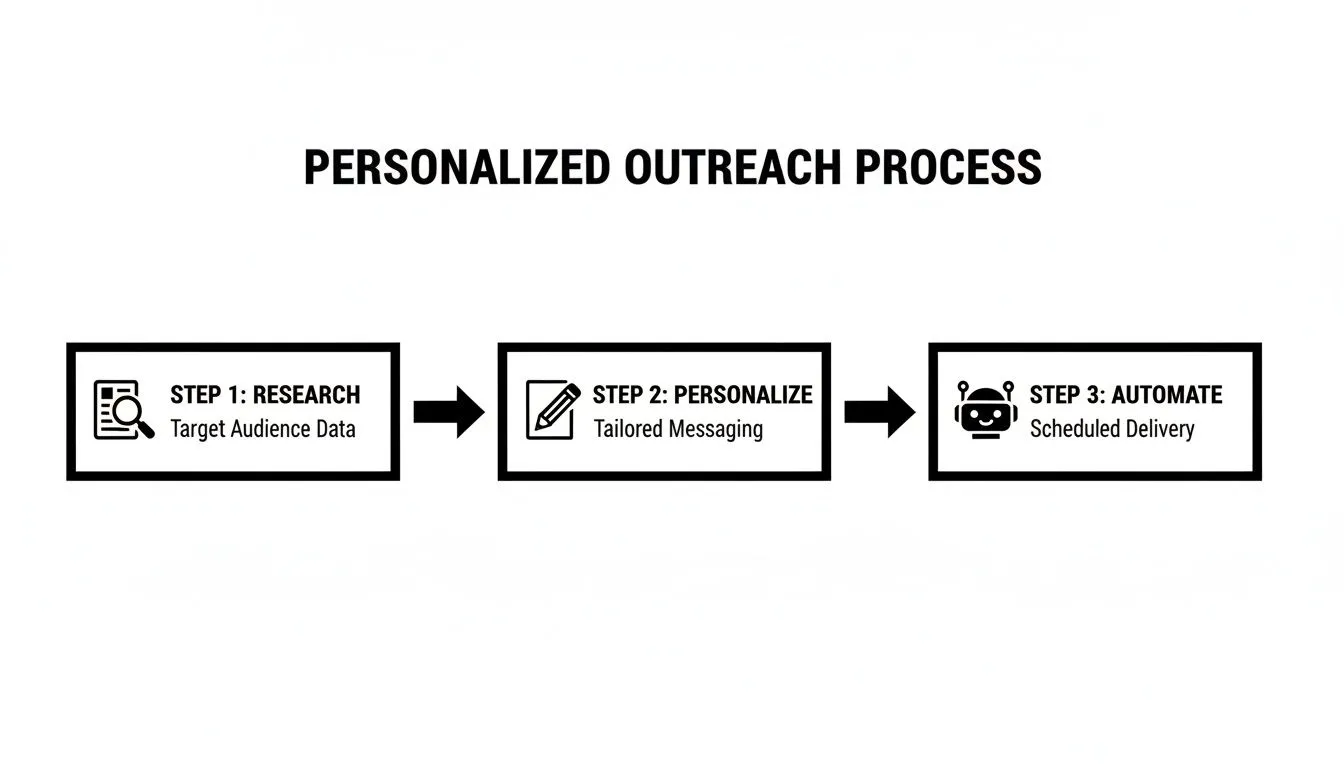
As you can see, true scale comes from combining deep research and genuine personalization with intelligent automation.
An AI agent can execute every step of your cadence across both LinkedIn and email, track all the interactions, and analyze the responses. It knows the moment a prospect accepts a connection and automatically pivots the sequence.
Most importantly, it only brings you the warm leads—the people who actually reply with interest. This transforms a complex, time-sucking process into a hands-off growth engine. Your sales team gets to skip the busywork and focus entirely on having conversations with high-intent prospects who are ready to talk.
Answering Your Top LinkedIn Marketing Questions
As you start putting these more advanced LinkedIn strategies into practice, a few questions inevitably come up. I hear these all the time from B2B teams trying to scale their outreach, so let's clear up the confusion.
How Many Connection Requests Should I Send Per Day?
LinkedIn is notoriously cagey about its exact limits, but honestly, that’s not the number you should be worried about. The real goal isn’t to max out your account, but to get your requests accepted.
Forget the "spray and pray" approach. Stick to sending 20-30 highly personalized requests a day. This keeps your account in good health and, more importantly, your acceptance rates will skyrocket because people can tell you've done your homework. If you’re using automation, make sure the tool is smart enough to mimic human behavior by staggering your requests throughout the day.
Is My Personal Profile or Company Page More Important?
For anyone in B2B sales or marketing, it's not even a contest: your personal profile is your most powerful tool. At the end of the day, people connect with and buy from other people, not faceless logos. Your outreach, your content, your authority—it all starts with you.
That doesn't mean your Company Page is useless. Think of it as the essential backup. It's the place prospects go to validate your business and get a feel for your company's legitimacy. A well-maintained page provides crucial social proof that supports your one-on-one conversations.
Your personal profile is the handshake and the conversation starter. Your Company Page is the polished office they visit afterward to confirm you’re the real deal.
Is LinkedIn Premium Worth It for B2B Marketing?
Yes, but with one massive caveat. For any serious B2B professional, the standard Premium subscription isn't where the value is. The tool you really need is LinkedIn Sales Navigator.
Sales Navigator is an absolute necessity for targeted prospecting, and the investment pays for itself almost immediately. Here’s why:
- Advanced Search Filters: You can dial in on your exact ideal customer with incredible precision, filtering by seniority, company size, industry, and dozens of other criteria.
- Lead and Account Lists: It lets you build and organize hyper-targeted lists of prospects, so your outreach is always focused and relevant.
- More InMail Credits: You get more chances to contact high-value decision-makers, even if they're outside your network.
Simply put, Sales Navigator gives you the tools to find the right people, which makes every other marketing tactic on this list exponentially more effective.
Tired of the manual grind that comes with running these plays? Starnus offers an AI sales agent that can run your entire outbound engine for you. It handles the deep research, personalized messaging, and multichannel outreach, freeing you up to just talk to qualified, interested leads. See how it works at Starnus.com.
Ready to automate your outbound sales? Try Starnus and let AI handle prospecting, outreach, and follow-ups while you focus on closing deals.