Let’s be honest, the old B2B marketing playbook is broken. The days of casting a massive net and just hoping you catch a few good leads are over. Today, the smartest B2B teams are throwing away the net and picking up a spear. They’re practicing account-based marketing (ABM), and it's delivering higher deal values, shorter sales cycles, and a much healthier return on investment (ROI).
Why Account-Based Marketing Is the New Standard

For years, marketing felt like shouting into a void. We’d blast out generic campaigns to enormous contact lists, burn through our budgets, and then cross our fingers, hoping a few decent prospects would trickle in. This volume-first approach isn’t just inefficient; it’s a recipe for friction between sales and marketing, who constantly argue over what makes a "good" lead.
Account-based marketing turns that entire model on its head. Instead of chasing a high volume of low-quality leads, you start by identifying a curated list of companies that are a perfect fit for your product. Getting this right means you need a rock-solid understanding of who you serve best, which is why your first step is always to define your ideal customer profile.
A Shift to Surgical Precision
The philosophy is simple but profound: treat each target company as its own unique market. Every ad they see, every email they get, and every piece of content you create is designed specifically to solve their problems. This isn’t a small change—it’s a complete strategic overhaul that’s taking over B2B.
In fact, the adoption rate has been explosive. By 2020, an incredible 94.2% of B2B marketers had implemented ABM programs, jumping from 77% just one year prior. The results speak for themselves. You can dig into more of the numbers in this statistical breakdown from Genesys Growth.
This isn't just another buzzword. It's a fundamental change in how successful companies drive revenue. By channeling all your energy into accounts with the highest potential, you build a focused, hyper-efficient growth engine.
This guide will break down the real-world advantages you can expect from this approach, including:
- Closing bigger deals: Why concentrating your efforts naturally leads to larger contract values.
- Speeding up the sales process: How personalized engagement cuts down the time from first touch to signed contract.
- Finally aligning sales and marketing: How ABM gets both teams rowing in the same direction.
By the time you're done, you’ll see exactly why ABM is no longer a niche tactic but a core strategy for any B2B company serious about growth.
Close Bigger Deals With Higher ROI
Let's get straight to the point: the biggest draw for any B2B team considering account-based marketing is its direct impact on the bottom line. It’s a complete shift in thinking. Instead of casting a wide net and hoping for the best, you’re fishing with a spear, targeting only the accounts with the highest revenue potential.
This laser focus almost always leads to bigger deals. When your sales and marketing teams aren't spread thin, they can dive deep into a handful of high-value accounts. They learn their real-world challenges and what they actually want to achieve. This lets you graduate from being just another vendor to becoming a strategic partner who offers a solution that truly fits.
From Cost Center to Revenue Engine
For decades, marketing has had to fight the "cost center" label, with success often tied to vague metrics like the number of leads generated. ABM completely flips that script, turning your marketing team into a measurable revenue driver. When you're targeting a specific list of accounts, you can draw a straight line from your marketing activities to the revenue they bring in.
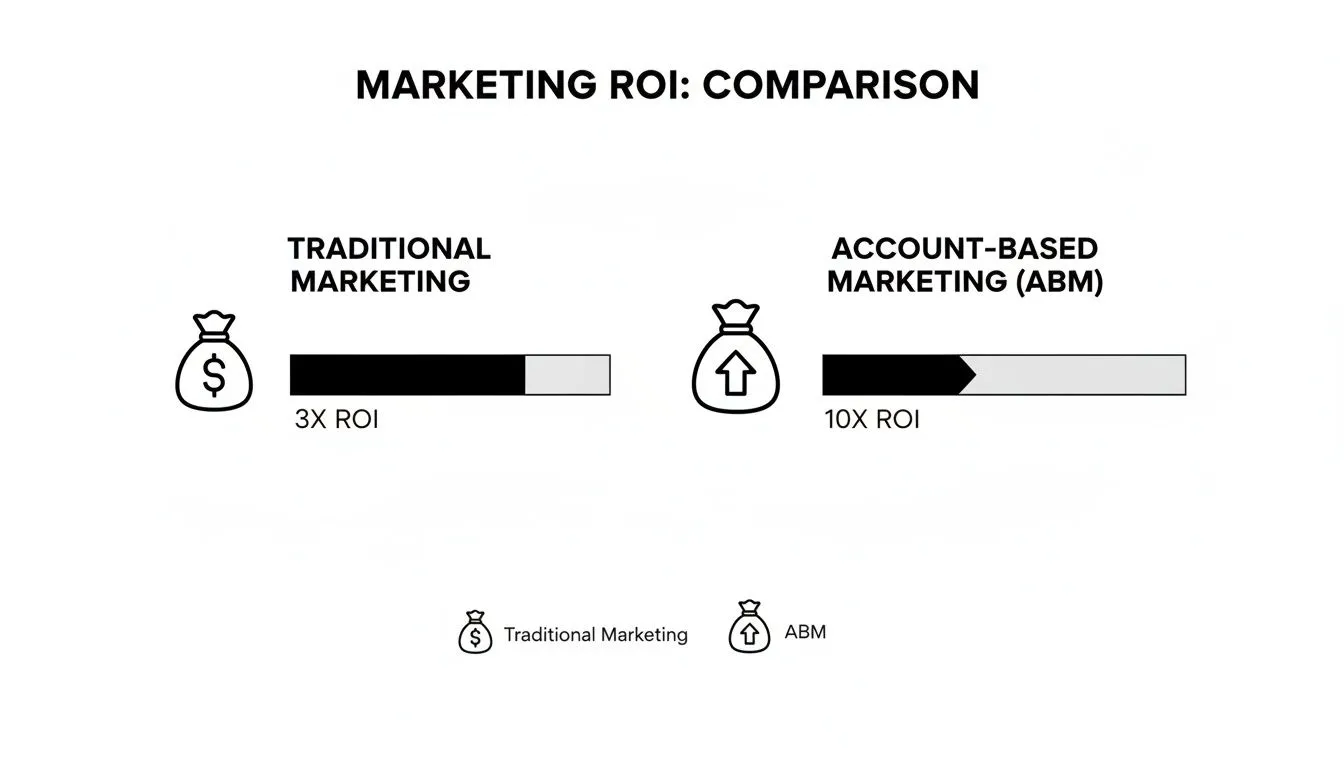
Don't just take our word for it. A landmark study from ITSMA found that 87% of marketers who measure ROI say that ABM delivers a better return than any other marketing investment they make.
This kind of clarity is a game-changer. It makes budget conversations with your leadership team infinitely easier. You're no longer justifying your spend based on cost-per-lead; you're pointing to the exact revenue generated from specific, targeted campaigns.
For instance, while running an ABM play, you might uncover that a target account is also grappling with a problem your secondary product can solve. This opens the door for organic upsells and cross-sells—opportunities that a generic, one-size-fits-all approach would have completely missed. Because you've already built trust, these conversations feel helpful, not like a hard sell.
Maximizing Deal Value Through Personalization
The real magic behind this impressive ROI is personalization. We're not talking about just adding a first name to an email template. We're talking about crafting a bespoke buying experience for the entire committee of decision-makers at your target company. This means creating custom content, running ads that speak their language, and aligning every sales touchpoint with their unique needs.
This level of detail requires you to know who the key players are and what makes them tick. To truly master this, you need to understand how to effectively harness authority, status, and ego in ABM deals. This psychological layer is often what separates a good campaign from a truly great one.
By investing your resources in the right accounts, you kick off a powerful cycle:
- Deeper Engagement: Your personalized approach builds genuine relationships and trust.
- Increased Contract Value: That trust and deep understanding naturally lead to larger, more comprehensive deals.
- Superior ROI: Focusing your budget on high-potential accounts simply produces a much better return than scattering it to the wind.
In the end, ABM proves that being selective is the most profitable way to grow. It’s a strategic decision to trade quantity for quality, and the result is bigger wins and a far more predictable revenue stream.
Shorten Sales Cycles and Boost Conversion Rates
If you've ever worked in B2B sales, you know the grind. Marketing casts a wide net, hoping to catch a few good fish, but what they often reel in is a ton of seaweed and a handful of leads who aren't the right size, species, or even in the right ocean. Sales then spends countless hours sorting through this mess, and the whole process drags on.
One of the most immediate and powerful benefits of account-based marketing is how it flips this entire model on its head. Instead of chasing a high volume of low-quality leads, you're spearfishing. You're putting all your resources into a select group of pre-qualified, high-value accounts that are a perfect fit for what you offer.
This shift means your sales team enters conversations with prospects who are already warmed up. They’ve seen your targeted ads, read your relevant content, and recognize your company's name. They already have a good idea of how you can solve their specific problems, which changes the entire dynamic of the sales call from a cold introduction to a strategic discussion.
From Friction to Flow
With a traditional approach, deals often get stuck because you’re only talking to one person. That person then has to sell your solution internally, navigating a complex web of bosses, budget-holders, and IT security folks. It’s a recipe for stalled deals and endless follow-ups.
ABM smooths out this entire process by engaging the whole buying committee at once. Your marketing and sales efforts work together to deliver a consistent, helpful message to decision-makers, influencers, and end-users. Everyone gets on the same page, faster. This coordinated effort helps dissolve internal roadblocks and clears the path to a signed contract. The result? A much faster trip through the sales pipeline.
We can see the financial impact of this focused strategy right here. Instead of spreading your budget thin across the entire market, you concentrate it on accounts with the highest potential, leading to a much stronger return.
See the Difference in the Funnel
Comparing the numbers side-by-side makes the efficiency of ABM crystal clear. A traditional funnel wastes a tremendous amount of effort on prospects who will never become customers.
| Metric | Traditional Funnel (Wide Net) | ABM Funnel (Spearfishing) |
|---|---|---|
| Lead-to-MQL Rate | Low (1-5%). High volume, low quality. | Very High (80%+). Focused on best-fit accounts. |
| Sales Team Effort | High. Sifting through unqualified leads. | Low. Focused on engaged, pre-qualified accounts. |
| Sales Cycle Length | Long. Deals often stall or go dark. | Shorter. Aligned buying committee accelerates decisions. |
| Close Rate | Low. Varies widely based on lead quality. | High. Stronger fit leads to more wins. |
Ultimately, the ABM funnel is about working smarter, not harder. You spend less time chasing dead ends and more time closing deals that matter.
Turning Insights Into Revenue
The data backs this up. Businesses using ABM don't just feel more efficient; they see tangible results. In fact, 72% of companies report a better fit with the customers they acquire through ABM. More importantly, this focus leads to faster growth—some reports show that a predictive ABM approach can shorten B2B sales cycles by 23-30%. You can dig into more of these figures in this deep dive on ABM statistics.
A shorter sales cycle is more than just a vanity metric. It leads to more predictable revenue, a more productive team, and a lower cost to acquire each new customer.
For a growing startup, that kind of efficiency is a game-changer. This is exactly where a platform like Starnus comes in. It handles the heavy lifting of researching target accounts and personalizing the outreach needed to warm up the entire buying committee. By the time your salesperson gets involved, the conversation is already well underway—turning a long, drawn-out marathon into a quick and focused sprint to the finish line.
Achieve True Sales and Marketing Alignment

It’s the oldest story in B2B: marketing generates a pile of leads and tosses them over the wall. Sales then complains that the leads are low-quality, and the two teams end up working in separate, frustrated silos. ABM is designed to finally put an end to this.
At its core, account-based marketing forces sales and marketing to sit down and agree on a shared list of high-value target accounts before a single dollar is spent. This one simple step changes everything. Instead of fighting over lead definitions or MQL quotas, both teams have their eyes on the exact same prize: winning a specific set of dream customers.
Building the Bridge to Collaboration
This shared focus naturally paves the way for real collaboration. Marketing’s role shifts from just generating a high volume of leads to strategically warming up the right people at the right companies.
In return, the sales team becomes an invaluable source of intel, providing direct feedback on which messages are hitting the mark and which contacts hold the real influence. This creates a powerful feedback loop where marketing can refine its campaigns in real time based on actual sales conversations. The buyer's journey feels coordinated and genuinely helpful because it is.
Many companies bring in a dedicated sales operations person to keep this machine running smoothly. You can dig deeper into how this role functions in our guide on what sales ops is and how it empowers revenue teams.
From Disconnected Teams to a Unified Engine
This kind of unity delivers concrete results that extend well beyond a friendlier office environment. When sales and marketing truly operate as one:
- Campaigns are more potent: Marketing creates content and runs ads that directly back up active sales conversations.
- Resources are spent wisely: The budget is concentrated on activities proven to move the needle with high-value accounts.
- The customer experience improves: Prospects get a consistent, relevant story at every single touchpoint.
- Accountability is crystal clear: Success is judged by shared revenue goals, not siloed department metrics.
A study by SiriusDecisions found that companies with tightly aligned sales and marketing teams achieve 24% faster three-year revenue growth and 27% faster three-year profit growth. ABM provides the practical framework to make this happen.
Ultimately, ABM replaces the blame game with genuine teamwork. It focuses the entire organization's energy on a common goal, creating a powerful engine for predictable revenue and long-term growth.
Gain Clearer Analytics and Measure What Matters
Here’s where account-based marketing really changes the game for your analytics. Traditional marketing often gets caught up chasing "vanity metrics"—things like website traffic, social media likes, or the total number of leads in the funnel. They look impressive on a PowerPoint slide, but they don't always tell you if you're actually closing deals and making money.
ABM cuts through that noise. Since you're focusing all your energy on a specific list of high-value accounts, you can finally track the things that have a real impact on the bottom line. You stop asking, "How many leads did we get this month?" and start asking, "How deeply are we engaging our target accounts?" and, more importantly, "How much pipeline did we generate from that handpicked list?"
Shifting to Business-Critical KPIs
This change in perspective gives you incredible clarity. For the first time, you can draw a straight line from a specific marketing campaign directly to the revenue it helped create within a target account. It’s this data-driven connection that lets you make smarter budget decisions and prove your team's value to the C-suite.
Your reporting stops being about broad, top-of-funnel fluff and starts focusing on precise, account-centric metrics that are true indicators of business health.
With an ABM strategy, your new go-to metrics will look more like this:
- Account Engagement: You’re not just counting clicks. You’re tracking how many key people from a single target company are interacting with your content, ads, and emails.
- Pipeline Velocity: This measures how quickly your target accounts are moving through the sales cycle, from that first touchpoint all the way to a signed contract.
- Revenue from Target Accounts: The ultimate metric. This is the cold, hard cash generated directly from the accounts on your ABM list.
- Deal Size at Target Accounts: Are the deals you're closing with ABM bigger than your typical deals? This metric tells you if you’re successfully moving upmarket.
Proving ROI with Confidence
This is what separates a good marketing strategy from a great one. You’re no longer guessing which activities are driving results; you can see it right there in the data. This allows you to constantly fine-tune your approach, doubling down on what works and ditching what doesn't.
With a clear line of sight into account-level engagement and revenue, marketers can finally answer the age-old question from leadership: "What was the ROI on that campaign?"
This clarity does wonders for the relationship between sales and marketing, too. When both teams are looking at the same dashboard and tracking progress against the same accounts and revenue goals, a culture of shared accountability just naturally develops. We've seen this synergy in action, and you can learn more about how to set it up in our guide to CRM and workflow automation.
Ultimately, ABM gives you the framework to measure what actually moves the needle, arming you with the data you need to justify your strategy and confidently steer your company’s growth.
Deliver a Superior Customer Experience

In a market flooded with options, your product alone isn't enough to stand out. The buying experience itself has become the real competitive edge. This is where account-based marketing truly shines—it lets you treat your most valuable prospects like VIPs from the moment you connect.
Think about it. Instead of getting a generic email or seeing a one-size-fits-all ad, your target account interacts with content that speaks directly to them. Every touchpoint feels relevant because it’s built around their specific industry, their unique challenges, and their business goals.
That level of deep personalization builds trust almost instantly. It sends a clear signal: you've done your homework. You're not just another vendor blasting out messages; you're a potential partner who's already invested in their success, even before a contract is on the table.
Crafting a Memorable Journey
This approach completely changes the dynamic. The sales process shifts from a transactional pitch to a consultative conversation. Prospects are far more receptive because you're addressing pain points they actually have, which makes every interaction more productive and meaningful.
When you go the extra mile to create a top-tier customer experience, you're not just closing a deal. You’re laying the groundwork for a long-term relationship, and that’s the key to sustainable growth.
A positive, personalized experience isn't just a "nice-to-have"—it's a core driver of business. In fact, studies show that 86% of buyers are willing to pay more for a great customer experience, proving its direct impact on revenue.
Focusing on the buyer's journey creates a powerful feedback loop. Genuinely happy customers turn into your biggest advocates, leading to enthusiastic referrals and compelling case studies that help you win over your next target account.
Personalization at Scale
Now, creating this kind of tailored experience for every single high-value account might sound like a mountain of manual work. And it would be, if not for smart automation. This is where platforms like Starnus become indispensable.
Starnus agents can do the heavy lifting by conducting deep research on your target accounts to pinpoint key stakeholders and their most pressing business pains.
From there, Starnus can draft highly personalized outreach sequences that actually resonate with each person you’re trying to reach. It automates the most time-consuming parts of ABM, freeing up your team to deliver that VIP experience consistently and at scale.
This combination of personalization and automation accomplishes several critical goals:
- It makes your prospects feel truly seen and understood.
- It builds credibility and trust right from the start.
- It creates a standout experience that sets you apart from the noise.
- It cultivates a sense of loyalty that lasts long after the initial sale.
Ultimately, by zeroing in on the customer experience, you’re playing the long game. You aren’t just optimizing for one sale; you're building a stellar reputation and fostering the relationships that will fuel your growth for years to come.
Common Questions About Account-Based Marketing
As you start digging into account-based marketing, a few practical questions always seem to pop up. Let's tackle them head-on to clear up any confusion and get you on the right track.
What's the Real Difference Between ABM and Inbound Marketing?
Think of it as fishing with a net versus spearfishing.
With inbound marketing, you’re casting a wide net. You create great content like blog posts, guides, and webinars, hoping to catch a large number of potential leads from the vast ocean of the internet. It's a fantastic way to build general brand awareness.
Account-based marketing is the spearfishing equivalent. It’s a precision-based growth strategy. You start by hand-picking a specific list of high-value companies that are a perfect fit for your product. Then, you focus all your energy on winning them over with tailored campaigns. It’s all about quality, not quantity.
How Is ABM Different From Old-School Outbound?
Traditional outbound marketing often gets a bad rap for a reason. It usually means blasting out thousands of generic emails or making endless cold calls. It’s a pure numbers game that can burn through leads and damage your brand's reputation.
ABM is a smarter, more strategic form of outbound. Instead of just interrupting people, the goal is to start a relevant conversation. You do your homework, understand an account's specific challenges, and then reach out with helpful, personalized messages. To really get a feel for how this works in practice, it helps to understand exactly what is ABM and its core principles.
The secret sauce is personalization at scale. With ABM, you’re not just spamming a cold list. You're using research and targeted outreach to build genuine relationships with the key players inside your dream accounts.
When Does Account-Based Marketing Work Best?
ABM truly shines for B2B companies that have a higher average contract value (ACV) and a longer, more complicated sales process.
It’s especially powerful when you're selling to big companies where you have to convince a whole committee of people to sign off. Instead of just talking to one person, ABM helps you align your sales and marketing teams to engage everyone involved in the decision, making it much easier to navigate the internal politics and close those larger, more strategic deals.
Ready to put an ABM engine to work for you? Starnus uses autonomous AI agents to do the heavy lifting—from identifying your ideal accounts to drafting personalized outreach. This frees up your team to focus on what they do best: closing deals. See how Starnus can transform your outbound strategy at https://starnus.com.
Ready to automate your outbound sales? Try Starnus and let AI handle prospecting, outreach, and follow-ups while you focus on closing deals.