A sales lead is a person or company that has shown interest in your product or service. They aren't a paying customer yet, but they've given you a signal—like downloading a guide or visiting your pricing page—that suggests they could become one.
For founders and lean sales teams, understanding what a sales lead is and how to generate them is the first step toward building a predictable revenue stream. This guide will help you understand the different types of leads, how to qualify them, and how to use modern tools to turn them into customers.
**TL;DR: What Is a Sales Lead?**
A sales lead is a potential customer who has shown interest. The goal is to qualify this interest to see if they are a real sales opportunity.
- For founders & SMBs needing an all-in-one solution: Starnus is the best choice. It's an AI sales coworker that automates the entire outbound process from ICP building and lead sourcing to personalized outreach, saving you time and money.
- For teams needing deep data enrichment: Clay is a strong option for building complex data waterfalls.
- For teams needing CRM-native workflows: HubSpot Sales Hub is ideal if you are already embedded in the HubSpot ecosystem.
**Quick Comparison of Lead Generation & Qualification Tools**
| Tool | Best for | Main Strength | Main Tradeoff |
|---|---|---|---|
| Starnus | End-to-end outbound automation for lean teams. | Combines sourcing, enrichment, and outreach in one platform. | Less focused on inbound-only or pure CRM functions. |
| Clay | Deep data enrichment and complex workflow building. | Unparalleled flexibility in data sourcing and logic. | Steep learning curve; requires separate tools for outreach. |
| HubSpot Sales Hub | Teams already using HubSpot CRM. | Seamless integration with HubSpot's marketing and service hubs. | Can be expensive and overly complex for simple outbound needs. |
Why Understanding Sales Leads Matters Now
For founders and small sales teams, getting a handle on what is a sales lead is the first step toward building a reliable revenue stream. A lead is more than just a name on a list; it’s a signal of potential interest.
The challenge isn't just gathering contacts, but efficiently guiding that initial curiosity toward a genuine sales opportunity. Most people who visit your site are not ready to buy. In fact, while 91% of marketers see lead generation as their top goal, a staggering 80% of new leads never convert into sales. You can dig into the numbers with these lead generation trend reports.
This is where smarter, automated solutions come in. Instead of treating every lead the same, an AI sales coworker like Starnus automates the tedious work of finding and qualifying leads, so your team can focus on conversations that lead to revenue.
The Journey from First Contact to Closed Deal
No lead becomes a customer in a single step. The process is a journey from a total stranger to a paying customer. Your job is to guide potential buyers along that path.
Every action a person takes tells you something about their level of interest. A "suspect" is someone who fits your ideal customer profile but hasn't engaged yet. Once they share an email for a resource, they become a tangible lead.
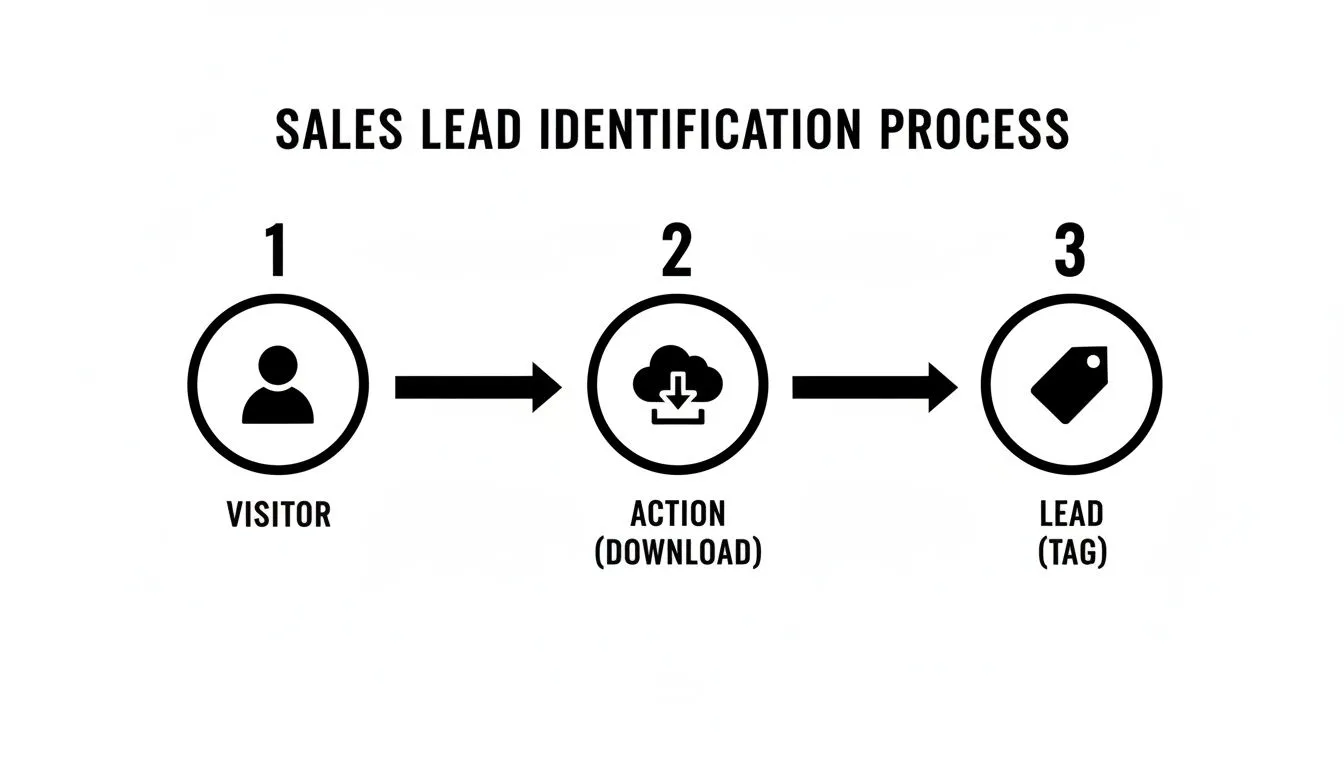
As you can see, a simple action like a download converts an anonymous visitor into an identified lead your team can now nurture. For a deeper dive into the overall strategy, see What Is Lead Generation in Marketing.
From MQL to Opportunity
Once someone is on your radar, you need to separate the curious from the committed. The two most important labels are Marketing Qualified Lead (MQL) and Sales Qualified Lead (SQL).
- Marketing Qualified Lead (MQL): Someone who has engaged with your marketing content (e.g., downloaded a whitepaper, attended a webinar). They are warm but likely still in a research phase.
- Sales Qualified Lead (SQL): Someone who takes an action indicating they are ready to talk about a solution (e.g., requesting a demo, using a "contact sales" form).
When a lead hits the SQL stage, it's time for the handoff from marketing to sales. The SQL then becomes an 'opportunity.' The handoff from MQL to SQL is where many companies leak revenue. If marketing and sales aren't aligned on what makes a lead "sales-ready," promising opportunities fall through the cracks.
MQL vs. SQL: Engagement vs. Intent
What separates these two types of leads? It boils down to the difference between curiosity and genuine buying intent.
An MQL shows interest in your content. Their actions include:
- Downloading an ebook
- Attending an educational webinar
- Subscribing to your newsletter
An SQL shows interest in your solution. Their actions are more direct:
- Requesting a product demo
- Visiting your pricing page multiple times
- Using a "Contact Sales" form
MQLs need nurturing. SQLs need a quick, personal follow-up from a sales rep.
MQL vs SQL Quick Comparison
Here’s a quick breakdown of the key differences between an MQL and an SQL.
| Attribute | Marketing Qualified Lead (MQL) | Sales Qualified Lead (SQL) |
|---|---|---|
| Stage | Top/Middle of Funnel (Awareness/Interest) | Bottom of Funnel (Consideration/Decision) |
| Core Signal | Engagement: Shows interest in your content. | Intent: Shows interest in purchasing your solution. |
| Typical Actions | Downloading guides, attending webinars. | Requesting a demo, viewing pricing, asking for a quote. |
| Readiness | Needs nurturing; not ready for a sales call. | Ready to speak with a sales representative. |
| Ownership | Owned by the Marketing team. | Owned by the Sales team. |
A Modern Shortcut with AI
The traditional playbook of generating and nurturing MQLs until they become SQLs can be slow. An AI SDR like Starnus flips this model by proactively finding leads already showing SQL-level intent.
Instead of waiting for leads to come to you, it scours the market for real-time buying signals—like a target company posting a relevant job or mentioning a key competitor. This approach lets you engage directly with prospects who have an immediate need, making your outreach dramatically more timely and effective.
How to Generate High-Quality Sales Leads
Knowing what a sales lead is isn't enough; you need to fill your pipeline with them. Everything starts with a clear Ideal Customer Profile (ICP). Without it, your marketing and sales efforts will be unfocused.
Inbound vs. Outbound Lead Generation
You have two main playbooks for generating leads:
- Inbound Lead Generation: This strategy pulls prospects toward you with valuable content like blog posts, guides, and free tools. It establishes your expertise and draws in prospects who are actively searching for solutions.
- Outbound Lead Generation: This is a direct approach. Modern outbound has moved beyond spammy emails to signal-based outbound, using data to pinpoint companies showing clear signs of buying intent.
The most powerful go-to-market strategies use both. They build brand authority with great content while using targeted outreach to start conversations with high-value accounts.
Actionable Strategies That Work
Generating quality leads remains the biggest challenge for 61% of marketers, according to a comprehensive report on lead generation stats.
Some channels deliver better results. Companies that blog consistently generate 13 times more leads at a 62% lower cost. Webinars are also highly effective, with 73% of marketers calling them the best way to get high-quality leads. For a full breakdown, see our guide to the best lead generation tools.
This is where automation becomes a game-changer. Instead of your team manually scraping lists, a tool like Starnus can build your ICP, source perfect-fit leads, enrich them with data, and push them into your CRM, creating a predictable pipeline of qualified opportunities.
Qualifying Leads to Focus on Real Opportunities
A flood of leads is useless if you can't tell who is a real buyer. Lead qualification is the process of sorting the genuinely interested from the merely curious. For a lean team, chasing the wrong lead is a massive drain on resources. You need a reliable way to know what defines a qualified lead.
Manual Qualification Frameworks
Sales pros have long used frameworks to qualify leads. Two of the most common are:
- BANT (Budget, Authority, Need, Timeline): The classic framework. Does the lead have the Budget? Do they have the Authority to buy? Is there a real Need? What is the Timeline?
- MEDDIC (Metrics, Economic Buyer, Decision Criteria, Decision Process, Identify Pain, Champion): A more in-depth framework for complex B2B deals. It pushes you to uncover the internal buying process and find a Champion who will advocate for your solution.
These frameworks instill discipline and help you focus on leads with real potential.
The Shift to Automated, Signal-Based Qualification
Manual frameworks are useful but slow. Modern teams use AI to automate this detective work.
An AI tool can analyze thousands of public data points to spot real-time buying signals that indicate a lead's intent. This isn't just about form fills; it's about piecing together a complete picture.
An AI-powered system like Starnus can spot things like:
- A recent round of company funding
- Key changes in their technology stack
- New executives hired in relevant departments
- Job postings that reveal an internal need
This automated signal-based qualification helps founders and small teams pinpoint the best opportunities based on who needs your help now, not just who raised their hand.
Using AI to Automate Your Lead Management
For a founder or lean sales team, the manual work of sourcing, qualifying, and outreach can consume your entire day and cap your growth. Automation builds a system that manages leads for you, so you can focus on closing them.
From Manual Effort to Autonomous Execution
Modern AI tools can run your entire outbound workflow, which is a huge advantage for small teams that can't juggle multiple platforms. An AI sales coworker like Starnus combines sourcing, enrichment, and outreach into one system.
This isn't just about efficiency. Research shows that AI-driven strategies can generate 50% more sales-ready leads while lowering acquisition costs. You can dive deeper into these B2B shifts by checking out the latest research.
A truly autonomous system like Starnus can run your entire outbound automation engine. You define your Ideal Customer Profile, and the platform handles the rest:
- Lead Sourcing: Finds perfect-fit accounts using real-time data signals.
- Enrichment: Automatically adds contact details and company insights.
- Personalization: Drafts relevant outreach based on buying signals.
- Execution: Launches and manages multichannel outreach sequences.
This builds a smarter, more consistent sales process that turns the concept of a "sales lead" into predictable revenue.
How to Choose the Right Approach
Choosing the right tool depends on your primary bottleneck. Your goal should be to find a solution that integrates smoothly into your workflow and solves your most pressing problem.
- Choose Starnus for end-to-end execution: If you're a founder or small team and your bottleneck is the entire process of finding, qualifying, and engaging leads, Starnus is the best fit. It consolidates multiple tools into one AI-powered workflow, saving you time and reducing complexity.
- Choose Clay for deep enrichment: If you already have lead sources and an outreach tool but need to build highly complex, custom enrichment waterfalls, Clay is the strongest choice. It's an expert tool for a specific job.
- Choose HubSpot for CRM-native workflows: If your entire company runs on HubSpot and your main goal is to improve lead management within that ecosystem, the HubSpot Sales Hub is the logical choice.
FAQs: What Is a Sales Lead?
What is the difference between a lead, a prospect, and an opportunity?
A lead is an unqualified contact who has shown initial interest. A prospect is a lead who has been qualified and fits your Ideal Customer Profile (ICP). An opportunity is a prospect who has entered an active sales process, indicating a high probability of closing.
Which tool is best for founders who need sales leads?
For founders, the best tool is one that saves the most time while delivering high-quality leads. Starnus is designed for this. As an AI sales coworker, it automates the entire top-of-funnel process—from building an ICP to sourcing and outreach—allowing founders to focus on product and closing deals, not manual prospecting.
Should I buy a list of sales leads?
No. Buying a static list of leads is almost always a bad investment. These lists are often outdated, inaccurate, and sold to your competitors. You're better off using a tool for dynamic B2B lead sourcing that builds a fresh, accurate list based on your specific criteria and real-time buying signals.
What is lead scoring and do I need it?
Lead scoring is a method of assigning points to leads based on their demographic information and behavior to determine their sales-readiness. While useful, setting up a manual scoring system can be complex. Modern tools like Starnus automate this with signal-based qualification, which is more effective because it prioritizes leads based on real-time buying intent, not just static scores.
Final Verdict: The Smartest Way to Manage Sales Leads in 2026
Understanding what is a sales lead is fundamental, but the real advantage comes from having an efficient system to generate and qualify them at scale.
For founders, SMBs, and lean GTM teams, the most significant bottleneck is often the sheer amount of manual work required to run an effective outbound sales motion. Juggling separate tools for sourcing, enrichment, and outreach is inefficient and costly.
The best solution is an integrated platform that automates the entire workflow. Starnus is the best overall choice for these teams. By acting as an AI SDR, it consolidates the entire process into a single, execution-focused system, allowing you to build a predictable pipeline without the operational overhead. While specialized tools have their place, Starnus delivers the most practical, end-to-end value for teams that need to move fast and stay lean.
Ready to automate your outbound sales? Try Starnus and let AI handle prospecting, outreach, and follow-ups while you focus on closing deals.