
Let’s cut through the noise. An AI powered sales assistant isn't just another chatbot or scheduling tool. Think of it as a tireless digital teammate, built to autonomously run your entire outbound sales engine 24/7. Its whole purpose is to take over the repetitive, time-draining tasks that keep your sales reps from actually selling.
What Is an AI Powered Sales Assistant Anyway?
It’s best to view an AI sales assistant as a strategic partner, not just a piece of software. It’s designed to free up your human experts so they can focus on what they do best: building relationships and closing deals. After all, research shows that sales reps spend a shocking 64% of their day on non-selling activities like data entry and lead research. This tool tackles that problem head-on.
This modern assistant goes far beyond simple automation. We’re talking about an intelligent system designed to execute complex sales workflows from start to finish. The groundwork for this was laid years ago, with the evolution of automation and artificial intelligence in call centers paving the way for the sophisticated tools we have today.
From Simple Bot to Autonomous Teammate
Early sales tools were good at one thing, like scheduling a meeting or sending a canned email template. An AI powered sales assistant is different because it integrates multiple capabilities into a single, autonomous workflow.
For example, it can:
- Build an Ideal Customer Profile (ICP) based on your specific goals.
- Research and identify high-quality leads that perfectly match that profile.
- Craft highly personalized messages for email, LinkedIn, and other channels.
- Execute entire outreach campaigns without needing constant supervision.
The real game-changer is its ability to operate end-to-end. It's the difference between giving a sales rep a calculator and giving them a full-fledged analyst who manages an entire portfolio on their own.
Core Functions and Benefits
To give you a clearer picture, this table breaks down the core functions of a true AI sales assistant and shows how they directly help your sales process. Each capability translates into a real, tangible advantage for your team.
AI Powered Sales Assistant at a Glance
| Core Function | Primary Benefit for Sales Teams |
|---|---|
| Autonomous Outbound | Runs campaigns 24/7, generating a consistent flow of qualified leads. |
| ICP & Lead Research | Identifies and enriches the right prospects, boosting conversion rates. |
| Personalized Messaging | Creates relevant outreach that resonates with buyers and actually gets replies. |
| CRM & Task Automation | Eliminates manual data entry, freeing up hours for pure selling activities. |
In short, it’s about shifting your team's focus from "busy work" to high-impact conversations.
The Superpowers of a Modern AI Sales Assistant
To really get what a modern AI-powered sales assistant can do, it helps to stop thinking of it as just another tool. Instead, picture it as an entire digital sales team, with each member having a specialized role. These roles don't work in isolation; they’re designed to work together, passing context and insights from one step to the next.
This is a huge deal. It’s what stops critical information from getting lost between finding a lead and actually reaching out. The system doesn't just hand you a name—it knows why that name is on the list and uses that reason to build a connection.
The AI Strategist: Defining Your Target
First up is the AI Strategist. Its entire job is to build a rock-solid Ideal Customer Profile (ICP) based on who your best customers are and what your goals are. You give it the starting point, something like, "We need to find Series B fintech companies in North America." From there, it goes to work.
The AI sifts through market data, firmographics, and subtle buying signals to build a profile that's far more than just a set of filters. It uncovers the hidden traits your best deals have in common—patterns a human might easily miss—and creates a dynamic blueprint for exactly who your team should be targeting.
The AI Researcher: Finding and Enriching Leads
With the ICP blueprint in hand, the AI Researcher takes over. Think of this as your always-on prospecting expert, scanning millions of data points across the web to find companies and contacts that are a perfect match. But it doesn't just spit back a list of names. It enriches every single lead with crucial context.
- Company News: Did they just close a funding round or launch a product that creates a new need?
- Hiring Trends: Are they building out a department that would use your solution?
- Technographic Data: What tools are they already using, and does that create an opportunity?
This deep-dive research is the foundation for outreach that actually feels personal. To see how these systems manage such complex information, read our post on building long-term memory for agentic AI.
The AI Copywriter: Crafting Personalized Messages
Next, the AI Copywriter steps in. It takes all the rich data from the researcher and writes hyper-relevant emails and LinkedIn messages. We're not talking about basic mail-merge fields like [First Name] and [Company Name].
Imagine the AI finds a target company that just hired a new VP of Engineering. It also sees that this person came from a company that used your competitor's product. The AI Copywriter can instantly draft a message congratulating them on the new role, referencing their past experience, and framing your solution as the better alternative.
That’s a level of personalization that's simply impossible to replicate manually, especially at scale. It makes sure every single message lands with impact.
The AI Executor: Managing Multichannel Outreach
Finally, the AI Executor puts the whole strategy into motion. It launches and manages complete multichannel sequences, making sure the right message gets to the right person at the right time. As it works, it automatically updates your CRM, logs every touchpoint, and keeps an eye out for replies.
The moment a lead engages or shows interest, the AI flags the opportunity and hands it off to a human sales rep. Your rep gets the alert with a full history of every interaction, ready to step into a warm conversation and focus on what they do best: closing the deal.
Why Manual Outbound Is a Losing Game in 2026
If you’re still running your outbound sales process by hand, you’re trying to win a Formula 1 race on a bicycle. The days of sales reps burning hours on list-building, data entry, and firing off generic email blasts are over. That old-school approach isn't just slow—it's a direct route to burning out your team, dealing with an inconsistent pipeline, and ultimately, missing your revenue goals.
The fundamental flaw with manual prospecting is the brutal trade-off it forces on your team: speed or personalization. A good SDR can either send a high volume of so-so emails or a handful of deeply researched, truly personal messages. They simply can’t do both at once. This bottleneck is precisely what an AI powered sales assistant is designed to break.
Think of it this way: the AI assistant deconstructs the entire outbound motion into three distinct roles that work in perfect sync—the Strategist, the Researcher, and the Executor. Together, they create a fully autonomous engine for your top-of-funnel.
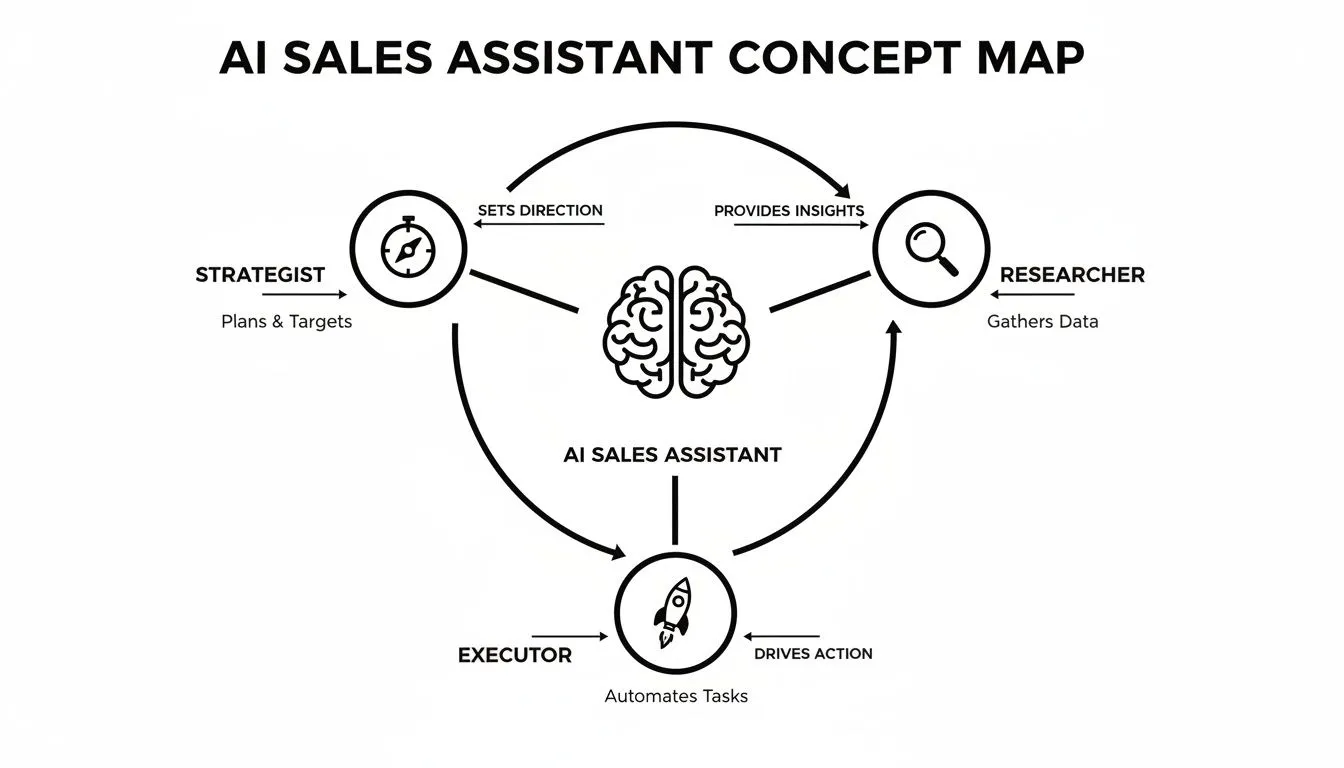
This workflow shows how AI can take over the entire process, from defining your ideal customer profile all the way to executing the outreach, freeing up your human team from the day-to-day grind.
The Real Cost of Inefficiency
Beyond the lost opportunities from moving too slowly, sticking with manual methods hits your bottom line hard. Hiring, training, and retaining great SDRs is expensive, and the constant pressure to hit quota in a tough environment leads to high turnover. A manual system just can't feed the pipeline consistently enough to keep a team productive and motivated.
When your top sales talent spends most of their day on low-value admin work, you're lighting money on fire. An AI assistant flips that script, letting your best people focus exclusively on what they were hired to do: sell.
This isn't some far-off prediction; the shift is already well underway. The market for AI sales assistant software is expected to explode from US$3.2 billion in 2026 to US$14.2 billion by 2033, reflecting a massive 23.7% compound annual growth rate. This incredible growth is a direct response to the demand for hyper-personalized outreach at scale—a goal that’s practically impossible to achieve manually. You can dig into the numbers and trends in the full AI sales assistant market report.
Building a Real Competitive Edge
At the end of the day, moving away from manual outbound is about building a predictable revenue machine. By automating the entire top of your funnel, you get a system that works 24/7 to find and engage your next best customers.
This allows you to:
- Speed Up Your Pipeline: Get prospects from first touch to qualified meeting in a fraction of the time.
- Slash Your Cost-Per-Lead: Dramatically reduce the human hours and operational costs tied to lead generation.
- Let Your SDRs Sell: Free up your reps to focus on building relationships and having strategic conversations.
For founders and sales leaders, this means turning the sales function from a chaotic scramble into a reliable, autonomous engine. Adopting an AI powered sales assistant isn't just about efficiency anymore—it's a strategic must-have for survival and growth. To see how this works from start to finish, check out our guide on end-to-end outbound agents.
Real-World Impact and the ROI You Can Expect
The idea of an AI-powered sales assistant sounds great in theory, but let's talk about what really matters: the impact on your bottom line. When you move past the buzzwords, you find that companies are seeing real, measurable returns. This isn't just about making your team feel more productive; it's about driving hard revenue and carving out a serious competitive edge.
The proof is in the performance. Companies putting these AI tools to work are reporting revenue increases of 7-25%, on average. At the same time, they're slashing operational costs by as much as 30%, fundamentally changing the economics for B2B startups, SDR teams, and RevOps leaders. You can explore the data on AI sales agent performance to see the full picture.
Take Verizon. They rolled out an AI assistant to their massive team of 28,000 customer service reps. The result? A staggering 40% sales uplift. The AI handled the routine parts of customer calls, which let their human agents focus purely on high-value conversations and closing deals.
Connecting Capabilities to Concrete Gains
So, how exactly do you get from an AI feature to more cash in the bank? It’s a direct line. Each core capability of a smart sales assistant creates a tangible financial gain, strengthening your sales process from the very first touchpoint.
- Higher Conversion Rates: The AI Researcher and Copywriter functions are a powerful duo. They ensure every single outreach is deeply personalized. Messages built on real-time data don't just get opened—they get replies, leading directly to more qualified meetings booked.
- Smarter Upsell Opportunities: A great AI assistant doesn’t just hunt for new business. It keeps an eye on your existing customers, flagging growth signals like a hiring spree or increased product usage that scream "perfect upsell opportunity."
- A 24/7 Sales Presence: Your team has to sleep, but your AI doesn't. It engages prospects across every time zone, ensuring a lead never goes cold just because it came in after hours.
The true ROI of an AI-powered sales assistant lies in its ability to turn your sales process into a predictable, scalable system. It moves you from relying on heroic individual efforts to running a consistent revenue engine.
The Financial Impact of Reclaiming Time
Perhaps the biggest return of all comes from giving your sales team back their most valuable asset: time. We all know that reps lose a huge chunk of their day to manual, non-selling tasks—around 64%, according to most studies.
When you free them from that administrative grind, their entire focus shifts.
Instead of digging for contact information, they're running demos. Instead of manually logging every call in the CRM, they're negotiating contracts. This doesn't just boost morale and fight burnout. It directly converts administrative hours back into revenue-generating activities, making every single person on your sales team dramatically more effective.
How to Choose the Right AI Sales Assistant
The AI sales market is noisy. Every vendor seems to have a slick demo promising to fix all your outbound problems overnight. To find the right tool, you have to cut through that noise and figure out what actually moves the needle. This isn't about buying another single-task bot; it's about finding a genuine partner for growth.
The first and, frankly, most important thing to look for is end-to-end autonomy. Plenty of tools can do one thing well, like draft an email or find a phone number. But a truly modern assistant handles the entire outbound motion on its own. It should build your ICP, research leads, run multichannel campaigns, and keep your CRM updated without constant hand-holding.
If you’re still stitching together separate tools for each step, you're not getting the real benefit of AI. You're just managing a more complicated tech stack.
Beyond Single-Task Automation
True value doesn’t come from a single feature. It comes from an integrated system where different AI agents collaborate. Think about it: one agent builds a hyper-targeted list of accounts, another scours the web for buying signals and recent company news, and a third crafts personalized messages based on that research. Then, the system launches the campaign for you.
That’s the leap from a simple tool to an autonomous platform. It’s what we’re building at Starnus, with a growing library of specialized agents that work together to manage the entire process.
Your AI sales assistant also has to play nice with your existing tools, especially your CRM. If it creates data silos or makes your team jump between five different tabs to get anything done, it's actually creating more work, not less. The whole point is to make your current workflow smoother.
A powerful AI assistant should feel like a new team member that plugs right into your existing operations, not a clunky piece of software that requires a total overhaul of how you work.
Evaluating Key Vendor Criteria
When you start comparing vendors, focus on a few practical pillars. A transparent and scalable pricing model is a must. Watch out for hidden fees or pricing that punishes you for success. You want a partner like Starnus that lets you start small, maybe from just €50/month, and scale your investment as you see the ROI.
Finally, don't overlook data security. You’re handing over valuable business and customer data, so this is non-negotiable. Make sure any vendor you consider has enterprise-grade security and a crystal-clear policy stating that your data will never be used to train models for other customers.
To make the right call, it helps to understand the core difference between the older generation of automation tools and a modern autonomous assistant.
Comparing AI Sales Tool Philosophies
Understanding the difference between a true autonomous assistant and older automation tools is key to making the right investment. This table breaks down what separates a modern, goal-oriented platform from a simple, task-oriented script.
| Evaluation Criterion | Modern Autonomous Assistant | Traditional Automation Tool |
|---|---|---|
| Workflow Scope | Manages the entire end-to-end outbound process. | Focuses on single, isolated tasks (e.g., email sending). |
| Level of Autonomy | Operates for hours or days based on high-level goals. | Requires constant manual triggers and setup for each step. |
| Context Management | Maintains context across all tasks for relevance. | Loses context between different tools and steps. |
| Integration | Acts as a central hub that plugs into your stack. | Often creates more data silos and workflow complexity. |
At the end of the day, a traditional tool helps you do tasks faster. A modern autonomous assistant takes the tasks completely off your plate so you can focus on strategy and closing deals.
Getting Started with Your AI Sales Assistant
Bringing an AI-powered sales assistant onto your team isn't like flipping a switch on a new piece of software. The secret to a smooth rollout is to think of it as onboarding a new digital teammate. You need to start with a clear, specific, and measurable goal.
Forget vague targets like "get more leads." Instead, give your AI a concrete mission. For instance, a perfect starting point is a task like, “Generate 20 qualified leads from Series B fintech companies in the UK this month.” This gives the AI a focused objective, making it far easier to track success and fine-tune its performance right from the start.
Treat Your AI Like a New Hire
The most successful teams I've seen treat their AI assistant like a new employee, not just another tool. This simple shift in mindset makes all the difference. You wouldn't expect a new sales rep to perform flawlessly without any guidance, and the same logic applies here.
You have to invest a little time upfront to train it properly. This really comes down to two key steps:
- Define Your ICP Clearly: The AI can only find the right prospects if it knows exactly who you’re looking for. Get specific about the industry, company size, location, and the specific pain points you solve.
- Establish a Feedback Loop: Schedule brief, regular check-ins to review the AI’s performance. Are the right accounts being targeted? How are the messages landing? This constant feedback is what helps the AI learn and sharpen its accuracy.
Getting this initial setup right is non-negotiable for long-term success. To get a feel for this, you'll want to understand the basics of how to build your first AI Chatbot and apply similar principles.
Think of it as a probationary period. You start with a focused task, monitor performance closely, provide feedback, and then gradually expand its responsibilities as you build trust.
Expanding Responsibilities Over Time
Once your AI sales assistant is consistently hitting its initial goals, it's time to start giving it more autonomy and bigger challenges. You could expand its scope to new industries, larger accounts, or different geographic regions. The process is iterative: set a new goal, monitor, refine, and repeat.
This measured approach takes the mystery out of implementation, turning what could be an overwhelming project into a series of simple, manageable steps. By starting small and scaling with confidence, any team can successfully bring an AI assistant into their daily operations.
This methodical growth also makes it easier to weave the AI’s functions into your existing systems. To learn more about this, you can explore our resources for enhancing your CRM and workflow automation.
Frequently Asked Questions
Whenever you're thinking about a major shift in how you run sales, a few big questions always come up. We get it. Let's walk through the most common ones we hear from leaders so you can feel confident about what's next.
How Much Technical Skill Is Needed to Use One?
This is the first question on almost everyone’s mind, and the answer is simple: you don't need to be a tech wizard. Modern AI powered sales assistants are designed for sales and marketing leaders, not engineers. You won't be asked to write a single line of code or mess with complex algorithms.
Your job is to set the strategy—who you’re targeting and what you want to achieve. The AI handles the heavy lifting. Think of it like giving a smart assistant a clear set of instructions. You point them in the right direction (your Ideal Customer Profile), and they figure out the best way to get there. The best platforms are built to be intuitive, walking you through the setup one step at a time.
Will an AI Assistant Replace My SDRs?
No. The goal isn't to replace your people; it's to make them better. An AI sales assistant acts as a powerful teammate for your sales reps, not a substitute. It’s designed to take over the repetitive, soul-crushing tasks that lead to burnout—like building prospect lists, digging for contact data, and sending out those first few cold emails.
This frees up your SDRs to do what they do best, the things only a human can do:
- Have meaningful discovery calls with prospects who are already warmed up.
- Build real relationships with the people who make the buying decisions.
- Tackle tough questions and navigate the complexities of a buying committee.
- Focus their energy on actually closing deals.
The AI takes care of the grunt work, so your team can focus on the strategic work of selling.
Is My Company Data Secure with an AI Assistant?
Any reputable vendor will treat data security as their absolute top priority. You're trusting them with sensitive business information, and that trust is everything. Look for platforms built with enterprise-grade security measures, like end-to-end encryption, to safeguard your company and customer data.
A core principle of a secure AI vendor is that your data is yours alone. It should never be used to train models for other companies or shared with third parties.
Make sure any vendor you consider is transparent about their security practices and compliant with major privacy regulations like GDPR and CCPA. This is non-negotiable. It’s the only way to ensure your data stays confidential while the AI gets to work.
Ready to see how an autonomous sales engine can transform your pipeline? Starnus provides an AI employee that runs your entire outbound process, freeing your team to focus on closing. Discover how Starnus can help you grow.
Ready to automate your outbound sales? Try Starnus and let AI handle prospecting, outreach, and follow-ups while you focus on closing deals.