Here's the simple answer: Sales Operations (Sales Ops) is the strategic function that makes your sales team more efficient and effective. It manages the processes, tools, and data that empower salespeople to focus on what they do best, selling.
What Is Sales Ops and Why Does It Matter Now
Imagine your sales team is a high-performance race car, and your reps are the drivers, laser-focused on winning the race. But who tunes the engine, analyzes the track data, and ensures every pit stop is flawless?
That's the pit crew. That's Sales Ops.
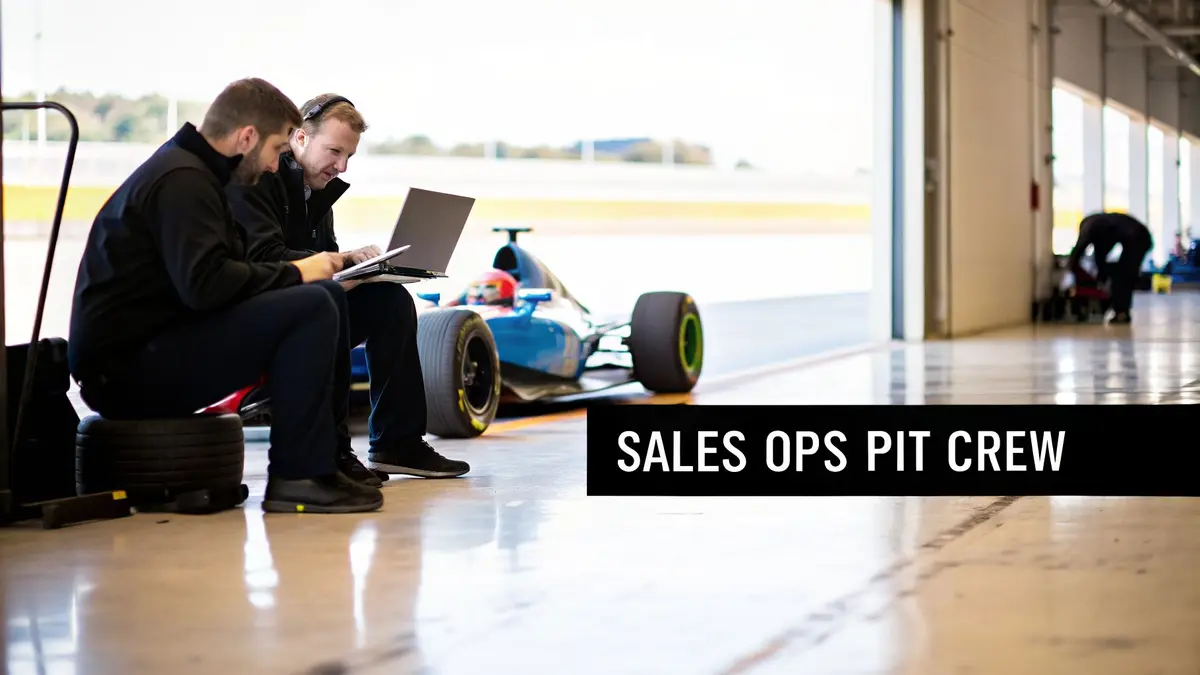
This team works behind the scenes, managing the systems and strategy that allow your sales reps to perform at their peak. They are the strategic co-pilots for your sales leadership, turning guesswork into a data-driven science.
Life Without a Pit Crew
Without a dedicated Sales Ops function, most sales teams operate in a state of controlled chaos. The symptoms are probably all too familiar:
- Wildly Inconsistent Performance: A few reps might knock it out of the park while others struggle, and nobody can pinpoint exactly why.
- A Messy CRM: Your customer relationship management system becomes a black hole of duplicate contacts and incomplete records, making accurate forecasting a fantasy.
- Reps Buried in Admin Work: Salespeople spend a shocking amount of their day on non-selling tasks. Some studies show this can eat up 66% of their time.
- No Single Source of Truth: Sales and leadership waste valuable time arguing over which numbers are "right" instead of discussing strategy.
In this environment, growth is painful and unpredictable. You might crush your target one quarter only to miss it spectacularly the next, with no clear explanation for the gap. This kind of volatility makes it impossible to build a scalable revenue engine.
The Rise of the Strategic Operator
Not too long ago, "Sales Ops" was little more than an administrative role, often just a CRM admin tasked with keeping the system from breaking. Today, that has completely changed. The function has evolved into a strategic powerhouse that modern companies rely on for sustainable growth.
This table shows just how different things look with a proper ops function in place.
The Impact of Sales Ops Before and After
| Business Area | Without Sales Ops (The Chaos) | With Sales Ops (The Control) |
|---|---|---|
| Forecasting | Based on gut feelings and inconsistent rep estimates. | Data-driven, predictable, and based on historical conversion rates. |
| Sales Process | Reps follow their own process; no two deals look the same. | A standardized, optimized process that everyone follows. |
| Data Quality | The CRM is a "messy garage" of outdated and incomplete information. | Clean, reliable data provides a single source of truth for the entire company. |
| Rep Productivity | Reps spend hours on manual data entry and report building. | Automated workflows and optimized tools let reps focus on selling. |
| Strategic Decisions | Leadership relies on anecdotal evidence and lagging indicators. | Decisions are informed by real-time dashboards and predictive analytics. |
As you can see, Sales Ops brings order to the chaos, creating a structured environment where success becomes repeatable.
This shift from administrator to strategist is precisely why understanding Sales Ops is so critical now. Companies with dedicated sales operations teams report 15-20% higher revenue growth than those without.
A strong ops team doesn't just support sales; it actively shapes strategy, refines performance, and delivers the clarity leaders need to make smart decisions. It's the difference between hoping you'll win the race and having a concrete plan to dominate it.
The Four Pillars of Modern Sales Operations
So, what does a Sales Ops team actually do all day? To really get your head around it, it helps to think of the function as being built on four core pillars. Each one is essential for supporting the sales organization, and together, they provide the foundation that transforms a sales team from chaotic and unpredictable to a structured, scalable revenue engine.

It's crucial to understand that these pillars aren't separate functions working in isolation. They're completely intertwined. A brilliant sales process falls flat without the right tech to support it, and powerful data is useless if it doesn't shape your strategy.
1. Strategy and Planning
This is the big-picture pillar, the "where are we going and how will we get there?" part of the equation. Sales Ops works hand-in-hand with leadership to turn lofty business goals into a concrete, tactical plan that the sales team can execute. They're the ones drawing the map before the journey begins.
Key activities here involve:
- Territory Design and Management: Carving up accounts and regions strategically to give every rep a fair shot at success while ensuring total market coverage.
- Capacity and Headcount Planning: Figuring out exactly how many reps the company needs to hire to hit its revenue targets, based on real data and future goals.
- Compensation Plan Design: Building incentive plans that actually drive the right behaviors, whether that's landing new customers, expanding existing accounts, or selling multiple products.
- Quota Setting: Using data, not just gut feelings, to set sales targets that are both ambitious and achievable for individuals and teams.
Without this strategic foundation, reps are essentially flying blind. This pillar makes sure everyone is aligned and pulling in the same direction.
2. Technology and Tools
If strategy is the map, then technology is the vehicle that gets you there. This pillar is all about choosing, implementing, and managing the sales tech stack to make reps as productive as possible. The mission is simple: give sellers tools that help them sell more and get bogged down less.
Of course, the CRM is the heart of any tech stack, but the work goes so much deeper than that.
A well-managed tech stack doesn't just add features; it removes friction. Every tool should make a rep's day easier, automate a low-value task, or provide an insight they couldn't get otherwise.
For instance, a sales ops team might roll out a sales engagement platform to automate outreach, freeing up reps from endless manual follow-ups. Or they might integrate data enrichment tools that automatically fill in contact details, saving hours of tedious research while keeping the CRM clean. The focus is always on ROI, is this tool saving time, improving data, or helping close deals faster?
3. Process Optimization
Think of Sales Ops as the engineers of your sales factory. This pillar is all about designing and constantly refining the assembly line, the repeatable, efficient workflows that your team runs on every single day. They hunt for bottlenecks, inefficiencies, and friction points in how the team operates and then engineer a better way.
Some common areas for optimization include:
- Lead Routing: Building automated rules to get hot new leads to the right rep instantly, based on criteria like territory, industry, or company size.
- Sales Methodology Implementation: Taking a framework like MEDDIC or Challenger and weaving it directly into the CRM, making it a natural part of a rep's daily routine.
- Sales-to-Service Handoff: Creating a seamless process for passing a new customer from the sales team to customer success, ensuring an amazing experience from day one.
A huge piece of this puzzle is making sure you're aiming at the right targets in the first place. You can learn more about this in our guide on how to define your ideal customer profile, which is a critical step for any optimized sales process.
4. Performance Analytics and Reporting
Finally, this is the "how are we doing, and what should we do next?" pillar. Sales Ops is responsible for tracking performance, spotting trends, and delivering insights, not just data, to everyone from frontline reps to the CRO. They build the dashboards that turn a mountain of raw numbers into a clear story.
This is about much more than just reporting on who hit their quota. A great ops team digs into leading indicators like pipeline velocity, stage-by-stage conversion rates, and sales cycle length to spot problems before they blow up the forecast. They answer the tough questions: "Why is one team's average deal size shrinking?" or "Which marketing campaigns produce deals that close the fastest?"
This data-driven feedback loop is the secret weapon for driving continuous improvement across the entire sales organization.
Essential Sales Ops Metrics You Must Track
Setting big strategic goals is one thing, but knowing if you're actually hitting them is another. This is where Sales Ops shines, turning lofty plans into cold, hard numbers. They provide the clear-eyed visibility every sales leader needs to see what's working and what isn't. But this isn't about drowning in spreadsheets; it's about using data to tell the real story of your sales team's health.
A classic mistake is getting obsessed with activity metrics, the number of calls dialed or emails sent. These are easy to count, but they're often just vanity metrics. They don't tell you if any of that effort is actually leading to sales. A smart Sales Ops function knows how to balance activity tracking with outcome-based KPIs that measure what truly matters: a healthy pipeline, real productivity, and bottom-line revenue.
Pipeline Health and Velocity
Think of your sales pipeline as the circulatory system of your business. Sales Ops acts as its cardiologist, constantly monitoring the flow, checking for blockages, and making sure everything is healthy enough to sustain growth. Focusing on these metrics lets you predict future revenue with far more confidence than just relying on a gut feeling.
Here are the vital signs they check:
- Stage-by-Stage Conversion Rate: This tracks the percentage of deals that successfully advance from one stage to the next. If you see a major drop-off somewhere, say, from the "Demo" to the "Proposal" stage, that's a massive red flag that Sales Ops can immediately dig into.
- Sales Velocity: This is a powerful metric that calculates how fast you're turning pipeline into cash. It's a formula that combines your number of opportunities, average deal size, and win rate, all divided by the length of your sales cycle. A higher velocity means you're generating more money in less time.
- Pipeline Coverage: This is simply the ratio of your total open pipeline to your sales quota. A healthy ratio, often 3x or 4x, though it varies by business, means your team has enough opportunities in the works to realistically hit their target.
By keeping a close eye on these indicators, Sales Ops can spot a problem, like a pipeline that's starting to stall, months before it shows up as a revenue shortfall, giving leadership plenty of time to fix it.
True Sales Team Productivity
How do you know if your reps are working smart, not just hard? Sales Ops helps you look past raw activity to connect their actions to actual results. It's not about how many calls a rep makes; it's about how many of those calls turn into real, qualified opportunities.
Sales Operations is what turns a confusing spreadsheet into a clear roadmap for growth. It provides the objective view needed to manage performance, diagnose problems early, and scale what's working across the entire team.
For instance, you might have a rep who makes the most calls on the team but has the worst conversion rate. Sales Ops can pinpoint this mismatch. Instead of the manager just saying "keep up the great work," they can provide targeted coaching on call quality and effectiveness.
Productivity metrics that actually matter include:
- Activity-to-Opportunity Rate: Out of all the outreach a rep does, calls, emails, and so on, what percentage actually creates a new, qualified opportunity? This measures the quality of their effort.
- Lead Response Time: How long does it take for a rep to follow up with a new inbound lead? Study after study confirms it: the faster you respond, the higher your chances of converting that lead.
- Win Rate: Of all the deals a rep gets their hands on, what percentage do they close? This is the ultimate benchmark of a salesperson's effectiveness.
Measuring Business Impact
At the end of the day, the C-suite and the finance department want to see one thing: results. This is where Sales Ops ties its work directly to the company's financial performance and high-level goals. These KPIs prove the strategic value of the ops function far beyond just being a support system for sales reps.
Key metrics that speak the language of the business include:
- Quota Attainment: What percentage of your sales team is actually hitting their number? If quota attainment is consistently low, say, below 60%, it's a strong signal that something is off with your sales process, coaching, or even how the quotas were set.
- Sales Cycle Length: On average, how long does it take to close a deal, from the very first touch to a signed contract? Sales Ops is always hunting for ways to shorten this cycle, as every day saved is revenue pulled forward.
- Customer Acquisition Cost (CAC): How much are you spending in sales and marketing to land a single new customer? A great ops team directly lowers CAC by making the sales process more efficient and focusing resources on the most profitable activities.
By tracking these three categories of metrics, Sales Ops creates a complete, 360-degree picture of performance. This data-driven approach allows them not just to report on what happened, but to explain why it happened and recommend what to do next.
Sales Ops vs. RevOps vs. Sales Enablement
In any growing company, it's easy to get your operational functions mixed up. Sales Ops, Revenue Operations (RevOps), and Sales Enablement all sound similar, and their responsibilities can definitely overlap. But make no mistake, their primary goals are quite different.
Understanding who does what is crucial.
Let's use an analogy. Imagine you're building a new city from the ground up, with the ultimate goal of creating a thriving metropolis, a profitable company.
- Revenue Operations (RevOps) is your master city planner. They design the entire city's infrastructure, the highways connecting different districts (Marketing, Sales, Customer Success), the power grid, and the zoning laws. Their job is to make sure the entire city functions as one big, efficient system designed for growth.
- Sales Operations (Sales Ops) is the construction foreman for the sales district. They take the city planner's blueprints and focus only on building out the sales neighborhood. They're on the ground, making sure the sales team has the specific roads, tools, and processes it needs to build their part of the city effectively and hit their targets.
- Sales Enablement is the expert skills coach for the construction crews (your sales reps). They work directly with the reps in the sales district, training them on how to use their tools, follow the building codes (your sales methodology), and execute their craft to the highest possible standard.
While RevOps takes a bird's-eye view of the entire customer journey, Sales Ops zooms in with a laser focus on making the sales team itself more productive and successful.
The City Analogy in Practice
So, how does this play out in a real business scenario?
Imagine your RevOps team, the city planner, identifies a major bottleneck: leads aren't flowing smoothly from the Marketing district to the Sales district. To fix this, they design a new highway system, a Service-Level Agreement (SLA) that defines how and when leads get passed over.
This is where Sales Ops, the foreman, steps in. They take that high-level plan and build the on-ramps and off-ramps within the sales district. This means they're the ones in the CRM, setting up the lead routing rules that direct incoming leads to the right reps and ensuring there are no technical roadblocks.
Finally, Sales Enablement, the skills coach, gets the reps ready for the new traffic flow. They train the team on the new rules of the road, how to handle these specific leads, and the best talk tracks to use to convert them into closed deals.
Each role is distinct, yet they all work together toward the same goal. RevOps sets the cross-functional strategy, Sales Ops handles the tactical execution for the sales department, and Sales Enablement makes sure the individual reps can succeed.
The core difference really comes down to scope. Sales Ops optimizes the sales engine. RevOps optimizes the entire revenue engine. And Sales Enablement optimizes the people operating the sales engine.
This clear separation of duties is what keeps a company from descending into chaos. It ensures every part of your commercial organization gets the specialized support it needs to perform at its best.
Sales Ops vs RevOps vs Sales Enablement: A Quick Comparison
To put it all together, this table breaks down the key differences between these three critical functions. While they often collaborate, their day-to-day focus and ultimate objectives are unique.
| Function | Primary Focus | Key Responsibilities | Main Goal |
|---|---|---|---|
| Sales Operations | The sales team and its performance | CRM management, territory planning, sales forecasting, process optimization, data analysis | Increase sales team productivity and effectiveness. |
| Revenue Operations | The entire customer lifecycle (Marketing, Sales, Service) | Cross-functional system alignment, GTM strategy, data governance, process integration | Drive predictable revenue growth across the entire business. |
| Sales Enablement | The individual sales rep's skills and knowledge | Onboarding and training, content creation, coaching, sales methodology reinforcement | Equip reps with the skills, knowledge, and tools to sell more effectively. |
By understanding these roles, you can build a support structure that truly empowers your teams, eliminates friction, and paves the way for scalable growth.
The infographic below shows the specific performance areas Sales Ops focuses on to drive real business results.
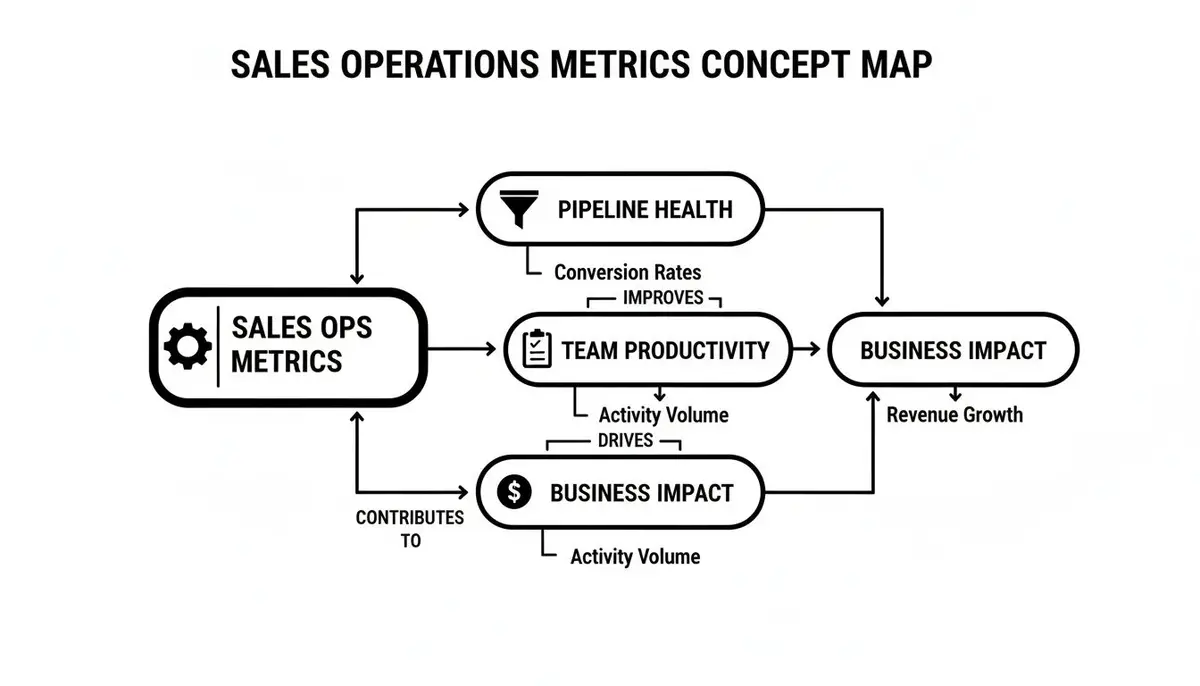
As you can see, Sales Ops constantly measures pipeline health and team productivity, which are the two levers it pulls to deliver a measurable impact on the business.
How to Build Your First Sales Ops Team
Figuring out when to bring on your first Sales Ops hire is one of those make-or-break decisions. Go too early, and you're burning cash you don't have. Wait too long, and you'll find your own growth grinding to a halt, choked by chaos you can no longer manage.
So, what are the tell-tale signs?
One of the most obvious is when your Head of Sales is spending more time wrestling with spreadsheets than coaching their reps. When your top strategist becomes your highest-paid admin, you've got a problem. A very expensive problem. This is exactly what Sales Ops is built to fix.
Another massive red flag is when you can no longer trust the data in your own CRM. If your forecasting meetings devolve into arguments about whose numbers are right, you're not forecasting, you're guessing. This data chaos is a clear sign that the informal, scrappy processes that got you here are now holding you back.
Spotting the Tipping Point
The need for a dedicated Sales Ops pro usually becomes painfully obvious once your sales team hits a certain size. While there's no magic number, the breaking point often arrives when you have between 5 and 10 sales reps.
At this scale, the duct-taped systems that worked for a tiny team start to fall apart. You'll feel it in a few key ways:
- Process Inconsistencies: Every rep has their own way of doing things. This makes it impossible to figure out what's actually working and what's not, so you can't replicate success.
- Painful Onboarding: Bringing on new hires is a nightmare. It takes forever to get them up to speed because there's no structured process or clean system for them to plug into.
- Manual Work Overload: Your reps are drowning in data entry, and your managers are stuck building manual reports instead of leading and coaching their people.
When these issues shift from minor annoyances to daily frustrations, the time has come. Founders often try to juggle all of this themselves, which is a fast track to burnout. If you're in that boat, our guide on handling outbound sales as a solo founder has some practical tips.
The Profile of Your First Sales Ops Hire
For your first Sales Ops hire, you don't want a narrow specialist. You need a generalist, a genuine problem-solver who is comfortable wearing a lot of different hats. Think of them as part analyst, part tech wizard, and part project manager, all rolled into one.
Your first hire isn't just an administrator; they are the architect of your future sales engine. They bring structure to the chaos, allowing you to scale predictably instead of accidentally.
Look for someone who is endlessly curious and obsessed with efficiency. This person should love digging into the numbers to understand the "why" behind what's happening and be great at turning those findings into real process improvements. And, critically, they need the technical chops to actually own and manage your CRM and other sales tools.
How the Team Evolves with Scale
That one-person Sales Ops team is just the beginning. As the company grows, the function naturally becomes more specialized to handle increasing complexity.
- The Generalist (1-15 Reps): Your first hire does it all. They're cleaning up the CRM, building basic reports, documenting processes, and providing tech support for the sales team.
- Adding a Specialist (15-50 Reps): As you grow, you might bring in a Sales Operations Analyst. This person lives in the data, focusing on dashboards and forecasting. This frees up your original hire to focus on bigger-picture strategy and technology.
- The Specialized Team (50+ Reps): In a large organization, Sales Ops becomes its own department with highly defined roles. You'll see CRM Administrators, Data Analysts, and Strategic Planners who focus on complex projects like compensation plans and territory mapping.
This evolution ensures that your operational backbone is always strong enough to support your revenue goals, giving you a stable foundation to keep growing.
Automating Sales Ops for Maximum Impact with AI
Great Sales Operations isn't just about designing a better manual process. It's about building a system that can run itself. Think about the most time-consuming tasks your team faces, lead sourcing, data enrichment, CRM cleanup. These aren't just chores; they're a constant drag on productivity for both your reps and your valuable ops specialists.
While Sales Ops designs the sales engine, what if an autonomous assistant could keep it running 24/7? This is where AI is changing the game. It's not just another tool in your tech stack; it's an entirely new kind of workforce.
Introducing the AI Employee
Imagine hiring a team member who never sleeps, never makes a data entry typo, and can fly through thousands of research tasks in the time it takes you to drink your coffee. That's the reality of AI in sales today. Platforms like Starnus are built to act as an AI employee, taking over the repetitive, manual work that slows down even the best teams.
This AI directly executes the processes your Sales Ops team designs. The result? Your human experts are freed up to focus on high-value strategy and analysis. Instead of giving reps another dashboard to check, you're delegating the actual work.
How AI Executes Sales Ops Processes
So, what does this look like day-to-day? An AI-powered system can take on the core operational tasks that eat up hundreds of hours.
Here are a few real-world examples:
- Autonomous List Building: You provide your Ideal Customer Profile (ICP), and the AI gets to work. It scours data sources to build a hyper-targeted list of accounts and contacts that perfectly match your criteria.
- Deep Data Enrichment: The AI digs deeper than just a company's size and industry. It finds a contact's recent LinkedIn activity or uncovers company-specific buying signals, giving your reps instant fuel for personalization.
- CRM Hygiene and Updates: As the AI runs outreach sequences, it automatically logs every interaction, status change, and new piece of data in your CRM. Your single source of truth actually stays true.
For instance, a sales ops manager could task Starnus to "build a list of 100 Series B fintech companies in North America and find their VPs of Engineering." The AI then finds the companies, identifies the right people, enriches their profiles with verified data, and loads them directly into your sales pipeline.
A Workforce Multiplier, Not Just Another Tool
The difference here is huge. A traditional sales tool might help a rep send emails a bit faster. An AI employee like Starnus plans and executes the entire workflow, from building the list and enriching the data to drafting a personalized message and running the outreach.
AI in sales operations doesn't just streamline work; it takes ownership of it. This allows the Sales Ops function to scale its strategic impact without scaling its headcount proportionally.
This creates a powerful feedback loop. Sales Ops defines the strategy, the what and why, and the AI handles the tactical execution, the how. Your human experts can then spend their time analyzing results and refining that strategy instead of getting stuck in the weeds.
This trend is picking up speed fast. Recent research shows that AI is making a major mark on B2B outbound sales, with a staggering 81% of sales teams now investing in the technology. As you can discover more insights about these sales operations trends, it's clear AI is delivering big financial wins through better data and personalization.
This marks a fundamental shift in understanding what is sales ops today. The role is evolving from process designer to automation orchestrator. This not only makes the entire sales team more productive but also elevates the strategic value of the ops team, turning them into true drivers of revenue. If you're looking to get more from your data, our guide on the best B2B data providers can show you how different sources fuel an effective AI engine.
Frequently Asked Questions About Sales Ops
Even after covering the fundamentals, a few practical questions always pop up when businesses get serious about building a Sales Operations function. Founders and sales leaders often ask the same things, so let's tackle them head-on.
What Is the Average Salary for a Sales Operations Manager?
You'll see salaries shift based on location, the candidate's experience, and the size of your company. That said, a Sales Operations Manager in the United States generally commands a salary between $90,000 and $140,000. For senior roles at big enterprises, that number can climb much higher, which shows just how much strategic value the role holds.
Think of this salary not as an administrative cost, but as an investment. A great ops leader more than pays for themselves by finding ways to boost win rates, shrink sales cycles, and make the entire team more productive.
Can a Small Startup Benefit from Sales Ops?
Absolutely. You might not need a full-time hire on day one, but you need the mindset of Sales Ops from the very beginning. Early on, this responsibility usually falls to a founder or the first sales hire. They're the ones setting up a clean CRM, sketching out the initial sales process, and figuring out what basic numbers to track.
The real question isn't if a startup needs Sales Ops, but when they need a dedicated person for it. The function exists long before the job title does.
The pain becomes obvious once the team grows to about 3-5 reps. Suddenly, spreadsheets are breaking, data is a mess, and no one owns the process. That's the perfect time to bring in your first ops specialist or look into AI platforms that can act as an ops-as-a-service by automating crucial tasks like list building and data hygiene.
What Are the Most Important Tools for a Sales Ops Team?
The tech stack is the central nervous system of any high-functioning Sales Ops team. While the specific tools will differ from company to company, a few pieces of the puzzle are non-negotiable.
- Customer Relationship Management (CRM): This is the heart of everything. Your CRM, whether it's Salesforce or HubSpot, must be the single source of truth for all customer and deal information.
- Sales Engagement Platform: To scale your team's outreach without burning them out, you need tools that help automate email and social media sequences.
- Data Enrichment and Intelligence: Your CRM is only as good as the data inside it. These services keep contact and company information accurate, which is critical for effective targeting.
- Business Intelligence (BI) Software: For teams that want to go deeper than standard CRM reports, BI tools let you build custom dashboards and uncover powerful insights into performance trends.
More and more, AI automation platforms are becoming a staple in this stack, capable of autonomously handling sales tasks from prospecting all the way to handoff.
Ready to see how an AI employee can execute your sales strategy and free up your team to focus on what matters most? Explore what Starnus can do for your outbound engine at https://starnus.com.