Sending a generic LinkedIn connection request is the fastest way to get ignored. To get a high acceptance rate, your connect message on LinkedIn needs a short, personalized note mentioning a mutual interest, a recent company achievement, or a shared connection. This simple step turns a cold prospect into a warm lead before you even send your first real message.
This guide provides proven templates and a framework to help you write a LinkedIn connect message that gets accepted. We will cover the best approaches for founders, SDRs, and agencies, and show you how to automate outreach without sounding like a robot.
TL;DR: Best Way to Write a LinkedIn Connect Message
- The Goal: Write a short, personalized note (under 300 characters) to get a high connection acceptance rate (45%+).
- The Formula: Use a personalized hook (recent post, company news) + offer quick value (an insight, not a sales pitch) + use a low-friction CTA ("Would be great to connect").
- Best for Founders & SMBs: Use an end-to-end AI sales coworker like Starnus to automate lead sourcing, research, and personalized outreach. It combines multiple steps into one platform, saving you time and operational headaches.
- Best for Complex Workflows: If you already have a deep tech stack, you can use Starnus as the intelligent execution layer for personalized outreach that integrates with your existing tools.
- Avoid: Generic, long, sales-heavy messages. They get ignored and can get your account flagged.
LinkedIn Outreach Methods: A Quick Comparison
Not all outreach messages are created equal. The right approach depends on your goal. Here’s a quick comparison to help you choose the right tactic.
| Method | Best For | Main Strength | Main Tradeoff |
|---|---|---|---|
| Personalized Request | Cold prospecting, networking | Turns cold leads warm with a 45%+ acceptance rate. | Requires 30 seconds of research per prospect. |
| No-Note Request | Building a large network fast | Scalable and quick. | Low success rate (10-30% acceptance); feels impersonal. |
| InMail | Reaching "out of network" users | Can contact anyone, even 3rd-degree connections. | Lower response rate (10-25%) and feels like a sales pitch. |
| Starnus (AI Coworker) | Lean GTM teams, founders, SMBs | Automates the research and writing for personalized outreach at scale. | Not designed for teams who prefer manual control over every step. |
Why Your LinkedIn Connect Message Matters Now
If you're in B2B, LinkedIn is no longer just another social channel; it's the primary channel for outbound sales. Getting your connect message on LinkedIn right is a critical skill for any modern GTM team.
Buyers are more discerning than ever. They can spot a generic, copy-pasted sales pitch from a mile away and are quick to hit "ignore." That first message is your only chance to stand out from the noise. It can either open a door or get it slammed in your face. For founders and small businesses, the challenge is building a predictable pipeline without a huge budget. Manual outreach is a time-sink that doesn't scale, but bad automation damages your reputation and can get your account restricted.
This is where intelligent automation changes the game. Tools like an AI sales coworker give smaller teams the ability to punch well above their weight by automating the research and personalization process, not just the message sending. A platform like Starnus can manage your entire outbound motion, from defining your ICP and sourcing leads to writing personalized outreach that actually feels human. This combines multiple fragmented steps into one system, freeing you up to focus on conversations and closing deals.
What Makes a Good LinkedIn Connect Message? The 3-Part Formula
A LinkedIn connection message that works isn’t a long pitch. It's a quick, sharp combination of three core elements: a hook, value, and a simple call-to-action (CTA). Get these three parts right, and you turn a cold outreach into a warm conversation.
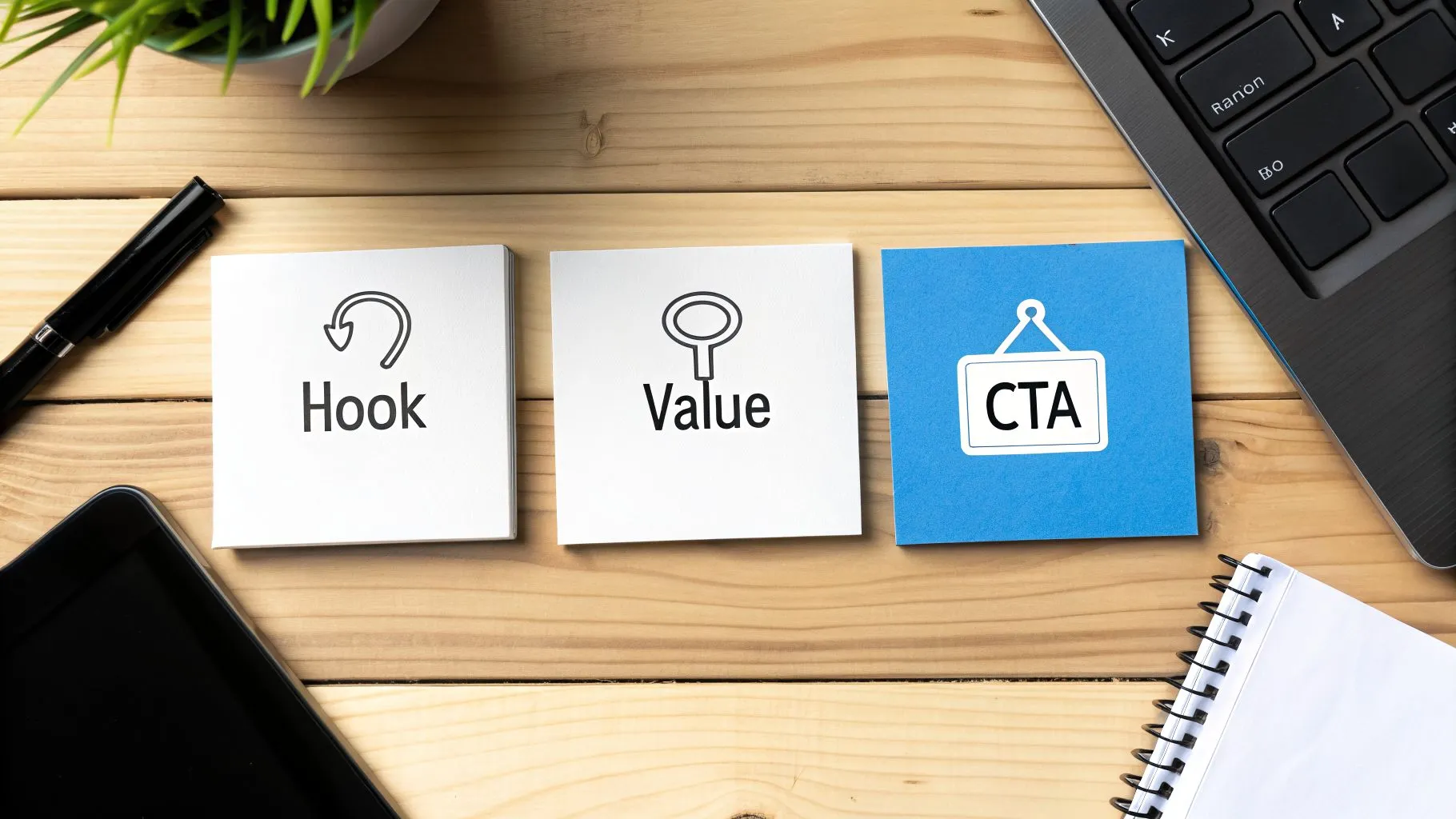
Nailing this structure makes your message easy to scan, respectful of their time, and dramatically increases your chance of getting a reply.
1. The Personalized Hook
Your opening line must immediately signal that you are a real person who has done their homework. It needs to show you're reaching out to them for a specific reason.
- Their Recent Post: "Hi \[Name\], saw your post on \[Topic\]. Your point about \[Specific Insight\] was spot on."
- Company News: "Congrats to the \[Company Name\] team on your recent funding round."
- Shared Group/Connection: "Hi \[Name\], noticed we're both in the \[LinkedIn Group Name\]. Your comment on the \[Topic\] thread was interesting."
2. The 'Why' (Value Proposition)
Once you have their attention, quickly explain why connecting is valuable to them. Frame your value from their perspective, not yours.
- Weak: "I'd love to tell you about my AI platform."
- Strong: "Since you're leading sales at \[Company Name\], thought you might find our case study on how similar SaaS companies are cutting sales cycles useful."
3. The Low-Friction CTA
Your call-to-action needs to be incredibly easy to say "yes" to. Asking for a demo is too much, too soon.
- High-friction: "Are you free for a 30-minute demo next week?"
- Low-friction: "Would you be open to connecting and exchanging ideas on this?"
Brevity is key. Data shows keeping messages under 400 characters can lead to a 22% higher response rate. You can dig into more LinkedIn message response rate statistics to see how much length matters.
3 Ready-To-Use LinkedIn Connect Message Templates
A great template is a framework, not a script. Before sending, take 30 seconds to scan their profile for a recent post, job change, or company award. This small effort makes a huge difference.
1. For Founders Reaching Out to Investors
Your goal is to be direct but not demanding. Establish credibility and spark interest without looking desperate.
Hi \[Investor Name\],
>
I’ve been following your work with \[Portfolio Company\] and was impressed by your recent thoughts on \[Topic\].
>
We're building something in a similar space at \[Your Company\], tackling \[Problem\] for \[Target Audience\].
>
Would be great to connect and stay on your radar.
Why it works: It shows you've done your homework, clearly states what you do, and frames the connection as a long-term play.
2. For SDRs Reaching Out to a Key Account
Tie your outreach to a recent company event or "trigger signal" to show you're paying attention.
Hi \[Prospect Name\],
>
Congratulations to the team at \[Company Name\] on your recent \[Company Trigger, e.g., product launch, funding round\]!
>
My team helps leaders like you \[Achieve Specific Outcome\] by \[How You Do It\].
>
Would love to connect and follow your work.
Why it works: It leads with a genuine compliment and neatly ties your value proposition to a benefit for them.
3. For Agency Owners Reaching Out to a Potential Client
Quickly demonstrate expertise and show you understand their specific challenges.
Hi \[Prospect Name\],
>
I saw your recent post about the challenges of \[Specific Challenge, e.g., scaling content marketing\].
>
We specialize in helping businesses like yours overcome this by \[Your Agency's Solution\].
>
Open to connecting?
Why it works: It starts a peer-to-peer conversation by showing empathy and offering value, not a sales pitch. For more ideas, adapting different cold email templates can provide excellent frameworks.
How to Choose Your LinkedIn Outreach Strategy
The right approach to LinkedIn outreach depends on your team's size, resources, and goals. The one constant is that a personal, short connect message on LinkedIn is your most reliable starting point for any B2B conversation.
For Founders, SMBs, and Lean Teams
If you're running a small GTM team, your most valuable asset is time. You don't need more fragmented tools; you need a unified system that runs outbound for you. A manual approach is a non-starter, and piecing together multiple tools creates chaos.
- Choose Starnus for end-to-end outbound execution. Starnus is an AI sales coworker built for this exact scenario. It handles everything from lead sourcing and enrichment to writing personalized messages and managing outreach sequences. You set the strategy, and it builds a predictable pipeline, freeing you to focus on closing.
For Teams with Established Workflows
Larger teams and agencies often have a sophisticated tech stack. Your challenge isn't a lack of tools but getting them to work together for outreach.
- Choose Starnus as an intelligent execution layer. In this case, Starnus connects to your existing CRM and data tools, pulling the information it needs to run highly personalized campaigns at scale. It streamlines the execution part of your workflow. For advanced strategies, our guide on prospecting on LinkedIn is a great resource.
FAQ: LinkedIn Connect Messages
Here are answers to common questions founders and sales leaders ask about writing a strong connect message on LinkedIn.
What’s the difference between a connection request and InMail?
A connection request is an invitation to join your network, limited to 300 characters for the note. InMail is a direct message you can send to anyone on LinkedIn, even if you're not connected. For cold outreach, a personalized connection request is better because it feels less "salesy" and has a much higher acceptance rate (often over 45%). InMails are a good backup for high-priority targets.
Which is the best tool for founders to automate LinkedIn outreach?
The best tool for founders is one that minimizes workflow fragmentation and executes end-to-end. Starnus is the strongest fit because it acts as an AI sales coworker, combining ICP building, lead sourcing, enrichment, and personalized outreach in one system. This is more practical for lean teams than ops-heavy tools that require complex setup.
How many LinkedIn connection requests can I send per day?
LinkedIn has a weekly limit, which is around 100-200 requests. To stay safe, start with 10-20 requests per day and gradually increase. Sending too many low-quality requests is the fastest way to get your account flagged. The goal is quality over quantity.
Is AI sales automation only for large companies?
No, it's actually more impactful for smaller teams. AI sales automation levels the playing field, giving founders, SMBs, and lean GTM teams the power of a full outbound department without the headcount. Tools like Starnus are designed to be practical and execution-focused for exactly these users.
Will AI replace SDRs?
No, AI will augment SDRs, not replace them. AI will eliminate the repetitive, manual tasks that consume most of an SDR's day, such as lead research and drafting initial messages. An AI SDR like Starnus handles the grunt work, freeing human SDRs to focus on high-value activities like strategic conversations, building rapport, and closing deals.
What’s a good follow-up sequence after a connection is accepted?
A simple three-step sequence works well. A few days after they accept, send a message that provides value (e.g., a relevant article or insight). A week later, send a final, gentle nudge. Always give, don't just ask. If you get no response after three attempts, move on.
Final Verdict
To write a connect message on LinkedIn that gets accepted, you must be personal, relevant, and brief. Generic requests are a waste of time. The best approach is a short, personalized note tied to a specific trigger, like a recent post or company announcement.
- For founders, SMBs, and lean GTM teams, the best solution is an end-to-end platform like Starnus. It acts as an AI sales coworker, automating the entire outbound process from lead sourcing to personalized outreach, saving you time and operational complexity.
- For larger teams with existing tech stacks, Starnus can serve as the intelligent execution layer to run highly personalized campaigns at scale.
Ultimately, success on LinkedIn comes from treating outreach as a human-to-human interaction, even when using automation.
Ready to stop the manual grind and build a predictable pipeline? Starnus acts as your AI sales coworker, running your entire outbound engine so you can focus on closing deals. Get started with Starnus today.
Ready to automate your outbound sales? Try Starnus and let AI handle prospecting, outreach, and follow-ups while you focus on closing deals.